A box is not rubbish. It is a container between jobs.
We buy, grade, repair, sell, haul and recycle used corrugated — gaylords, shippers, octabins, pallets, the lot. Most of what we sell has already worked once, and is measurably better than new at doing it again.
Tell us what you need
Sizes, grades, counts. It lands with a grader on our floor — one business day, always. Required fields are marked *.
We do the whole circle, not one slice of it.
Most suppliers sell boxes. Most haulers move them. Most recyclers bale them. Doing all three out of one yard is what makes the second life cheap enough to be worth having.
Numbers we are prepared to show the workings for.
Every figure here comes from marked containers passing through our gate, not from an industry brochure. Ask us for the spreadsheet and we will send it.
Five families of product, one grading scale.
From a 12-inch cube to a 60-inch harvest bin, and the honeycomb panel we press out of whatever is too tired to ship.
Send a photo instead of a spec.
A single picture of the stack, with a tape measure in it if you can manage, tells us more than any form. Email it and we will do the maths.
Box Studio: fold a box in your browser.
Drag three sliders. Watch the container resize in real time, flip it into its flat die-line, and read off the cube, the pallet fit, the trailer count and the carbon you avoid by not buying it new. Then hand the exact spec to us in one click.
It is the same calculator our graders use on the floor. We got tired of running it for people over email.
Recover · grade · repair · re-face · re-issue · convert · recycle · report.
This is the whole business on one line. Every step happens inside one building on Meeks Boulevard, which is the only reason the economics work.
Recover
We collect used corrugated and gaylords from docks, MRFs, farms and plants — on scheduled routes, usually as a backhaul on a trailer that was returning empty anyway.
Grade
Every container is inspected by hand within 24 hours of arrival. Flap edges, corner squareness, liner colour, score integrity. A, B, C or recovery.
Repair
Anything repairable goes to the bench, not the baler. Flap splices, patch panels, re-scoring, edge reinforcement — all using recovered board.
Re-face
Label and residue removal, blank-out printing, optional single-colour marking. A box that looks presentable gets used; a box that looks like rubbish gets thrown away.
Re-issue
Re-graded, bundled, banded and released into saleable stock or back into a customer's dedicated pool, knocked down for freight efficiency.
Convert
Containers past structural reuse become dunnage, honeycomb panel, displays and upcycled goods. Material, not waste.
Recycle
Genuinely spent fibre is baled to mill grade #11 / #12 OCC with moisture control and contamination logging.
Report
Monthly diversion statements: tonnage reused, tonnage recycled, landfill avoided, CO₂e avoided — with every assumption attached.
We would rather show you a grade B box than describe one.
Half the arguments in this trade come from the word “used” meaning four different things. Drag the lens and watch the same container age from like-new to recovery-only.
- Every inbound container graded by hand within 24 hours
- Grade written on the quote, not implied by the price
- Repairable boxes go to the bench, never straight to the baler
- Mixed loads priced as mixed loads — no quiet downgrades
Grade B — Good, light wear
Minor surface scuffs, light creasing on one panel, clean interior. All flaps intact and fully functional.
We write things down. Forty times so far.
No guest posts and no borrowed statistics — every piece comes out of our own yard, our own data or our own mistakes.
What is a gaylord box, exactly?
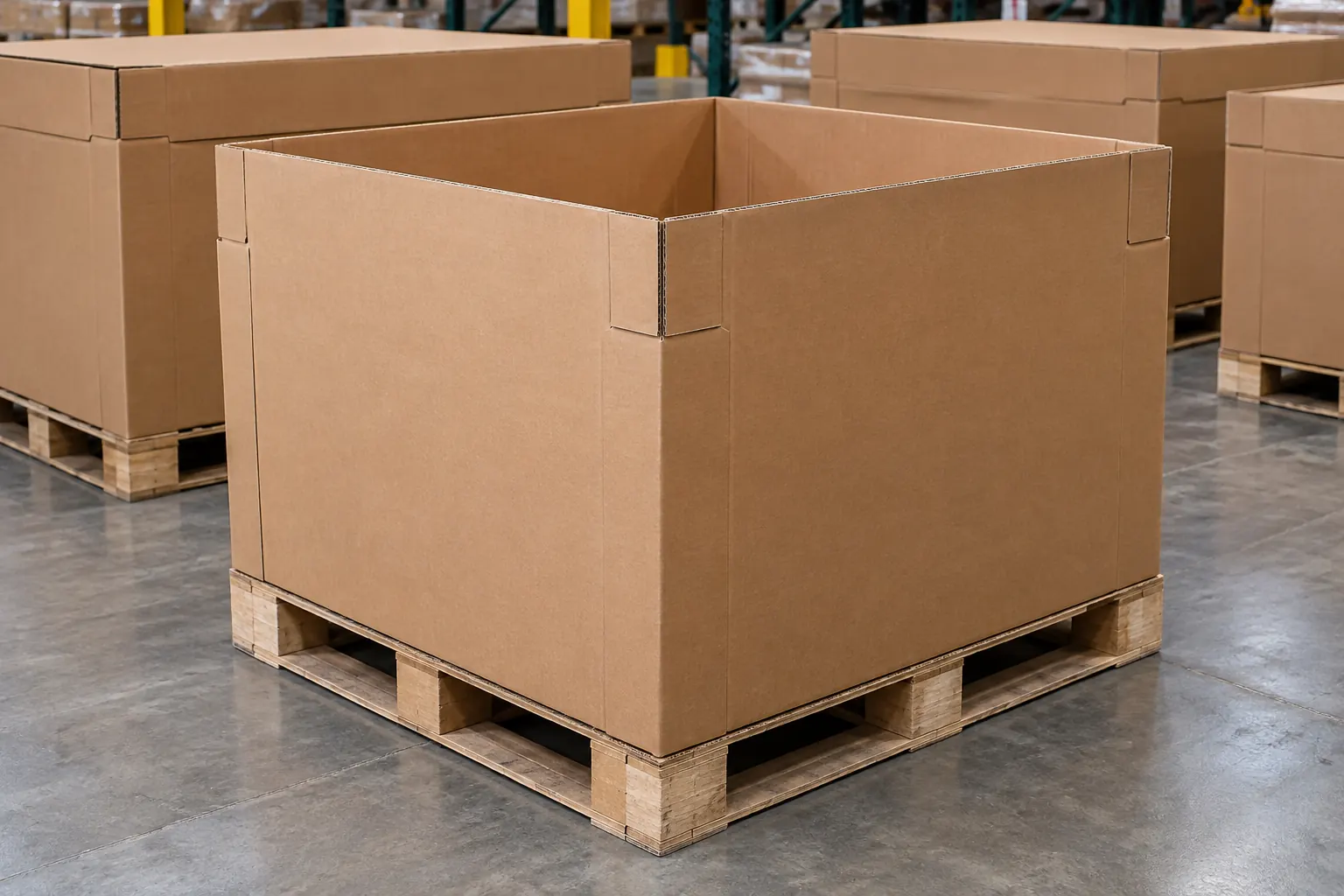
A gaylord is a large, usually triple-wall corrugated bulk container sized to sit on a standard 48" × 40" GMA pallet. The name comes from the Gaylord Container Corporation, which popularised them — it is a brand name that became a generic term, like dumpster. Typical capacity is 1,800 – 2,200 lb and around 40 cubic feet.
Do you really sell used boxes, or refurbished ones?
Both, and we are explicit about which. Grade A and B boxes are used as-is after inspection. Reconditioned boxes have had flaps spliced, panels patched or scores rebuilt at our bench, and are re-graded afterwards. Every quote states which you are getting.
What is your minimum order?
One pallet for gaylords (typically 20 – 24 knocked-down boxes). For RSC shippers, 250 boxes or a mixed pallet. Below that we will usually point you to a local supplier rather than charge you freight that makes no sense.
How do you price used boxes?
Grade, size run, volume and lane. A matched run of 2,000 grade-B 18" cubes prices very differently from 2,000 mixed boxes of random sizes, because sorting is the expensive part. We quote delivered, with the freight shown separately.
Six things move the number, and volume is only the fourth.
Used box pricing confuses people because the obvious lever — how many you want — is among the weakest of the six. Spread is the gap between best and worst case on our own quote data.
| Factor | Spread | Why |
|---|---|---|
| Destination lane | 2.8× | Within-Midwest versus a long nationwide haul |
| Size-run consistency | 2.1× | A single matched size versus genuinely mixed sizes |
| Grade | 1.9× | Grade C versus grade A on the same size |
| Order volume | 1.3× | One pallet versus a full truckload, same lane and grade |
| Timing flexibility | 1.15× | Take-it-when-it-lands versus a fixed delivery date |
| Season | 1.1× | March versus October on the same lane |
Eight failure modes, coded from our own retirements.
Ordered by share of retired containers. Note how few are repairable, and how many are prevented by something that costs almost nothing.
| Failure mode | Share | Repairable? | What prevents it |
|---|---|---|---|
| Forklift tine strike, lower long panel | 31% | Rarely | Floor approach guides, full-deck pallets, slower pick-face speed |
| Moisture through the flutes | 26% | No | Pallets not concrete, covered storage, let cold trailers equalise |
| Top-edge crush | 18% | Sometimes | Telescoping lids on anything stacked or racked |
| Strapping cut at the corner | 9% | Sometimes | Corner boards — the cheapest fix on this list |
| Corner rounding from over-stuffing | 7% | No | Do not fill above the top score line; buy the taller box |
| Cracked score lines | 5% | Yes, re-score | Separate lids instead of repeatedly folded flaps |
| Manufacturer's joint failure | 3% | Yes | Prefer stapled joints over glued for reuse |
| Delamination | 1% | No | Moisture control; there is no other cause worth chasing |
Every number we multiply by, in one table.
Take these, argue with them, substitute your own. Two have changed because a customer arrived with better data, which is the entire point of publishing them.
| Factor | Value we use | Range in literature | Note |
|---|---|---|---|
| Virgin corrugated, cradle-to-gate | 1.30 kg CO₂e / kg | 1.1 – 1.6 | Mid estimate; includes inbound freight |
| Recycled-content corrugated | 0.85 kg CO₂e / kg | 0.6 – 1.1 | Varies hugely with mill energy mix |
| Reuse cycle (collect, grade, repair, issue) | 0.215 kg CO₂e / kg | 0.17 – 0.25 | Our own measurement, trailer-allocated |
| Repair-and-reuse cycle | 0.275 kg CO₂e / kg | 0.22 – 0.33 | Adds bench labour and repair board |
| Conversion to honeycomb or dunnage | 0.49 kg CO₂e / kg | 0.4 – 0.6 | Destroys the container, keeps the sheet |
| Recycling to new board | 0.76 kg CO₂e / kg | 0.6 – 0.95 | Consumes one of the fibre's five to seven lives |
| Triple-wall gaylord board weight | 18.5 lb | 17 – 20 | 48 × 40 × 36, no lid |
| Median trips per gaylord | 9 | 4 – 14 observed | Marked-container study, n = 4,200 |
| Trailer packing efficiency | 72% | 65 – 80 | Knocked down and banded |
| Landfill density, loose OCC | 80 lb / yd³ | 50 – 110 | Used for volume-avoided figures |
We deliberately exclude end-of-life recycling credit, carbon stored in the fibre and avoided landfill methane. All three would improve our figures and all three are contested.
A box is worth more as a box than as fibre
That sentence is the entire company. A triple-wall bulk container sold as a container is worth many times the same board sold to a paper mill as a commodity, and the gap between those two numbers pays for everything we do — the grading floor, the repair bench, the honeycomb press and the trailers.
Which means the environmental argument and the commercial one point in exactly the same direction. That is unusual, and it is the only reason an operation like this survives a bad quarter rather than being quietly shut down as a corporate gesture.
Why reuse multiplies recycling rather than competing with it
Corrugated fibre can go round the recycling loop roughly five to seven times before it becomes too short to form a strong sheet. Every reuse cycle postpones one of those events. A box reused nine times and then recycled five times has delivered forty-five useful lives; the same box pulped immediately delivers five.
This is the most underused fact in packaging sustainability, and it is why a diversion percentage that treats reuse and recycling as equivalent gets the ranking exactly backwards.
What limits container life — and it is not the board
We marked 4,200 gaylords and counted every return. Median nine trips, top decile fourteen, bottom decile four. The spread is almost entirely handling: forklift tine strikes to the lower third of a long panel, condensation from a cold trailer into a warm dock, over-stuffing above the top score line, and strapping applied straight onto an unprotected corner.
Pushing a container fleet from four trips to nine is the highest-return sustainability project most warehouses have available, and it requires no capital whatsoever.
Six things that are different here.
Not claims about service quality — specific operational decisions you can hold us to.
Grading on inbound
Every container inspected by hand within 24 hours of arrival, not on the way out. Grading late means damaged boxes re-enter circulation and fail in your rack.
A named grade on every quote
A, B, C or mixed, with the published definition attached. A price without a named grade is a hope, not a quote.
Photographs of the actual lot
Not stock imagery, not a representative sample — the pallet you would receive, with grade notes.
Delivered pricing
Freight shown separately with the cube arithmetic attached, so you can check that the number makes sense.
One building
Inbound, grading, repair, conversion, baling and outbound all under one roof. Reuse margins do not survive being trucked between three sites.
Published numbers, including bad ones
Our contamination rate rose for two quarters in 2023 and we put it in the same statement as the good figures.
How long each thing actually takes.
Measured from a confirmed order, not from the first email. Artwork approval and procurement onboarding sit outside these figures and are usually the real critical path.
| Item | Lead time | Note |
|---|---|---|
| Graded used shippers, stock size | Same week | Often 48 hours on Midwest lanes |
| Graded gaylords, stock size | Same week | Knocked down and banded |
| Reconditioned gaylords | 7 – 10 days | Bench time plus re-grading |
| Lids, liners and accessories | Same week | Ships on the same pallet |
| Recovered pallets, repaired | 3 – 7 days | Depends on repair queue |
| New stock-size boxes | 2 – 5 days | 60+ sizes held in St. Louis |
| New custom die | 10 – 15 working days | Includes die making and first article |
| Printed new board, 1 – 4 colour | 10 – 15 working days | Plate making included |
| Honeycomb panel, stock | 5 days | Pressed from recovered board |
| Die-cut dunnage to profile | 7 – 10 days | Tooling for non-standard profiles adds time |
| Printed retail display | 10 – 12 days | Artwork approval is usually the critical path |
| Baler placement | 2 – 4 weeks | Site survey, delivery and commissioning |
Two and a half million boxes have come through this room.
Every one of them graded by hand within twenty-four hours of arriving — because grading late means damaged containers re-enter circulation and fail in somebody's rack.
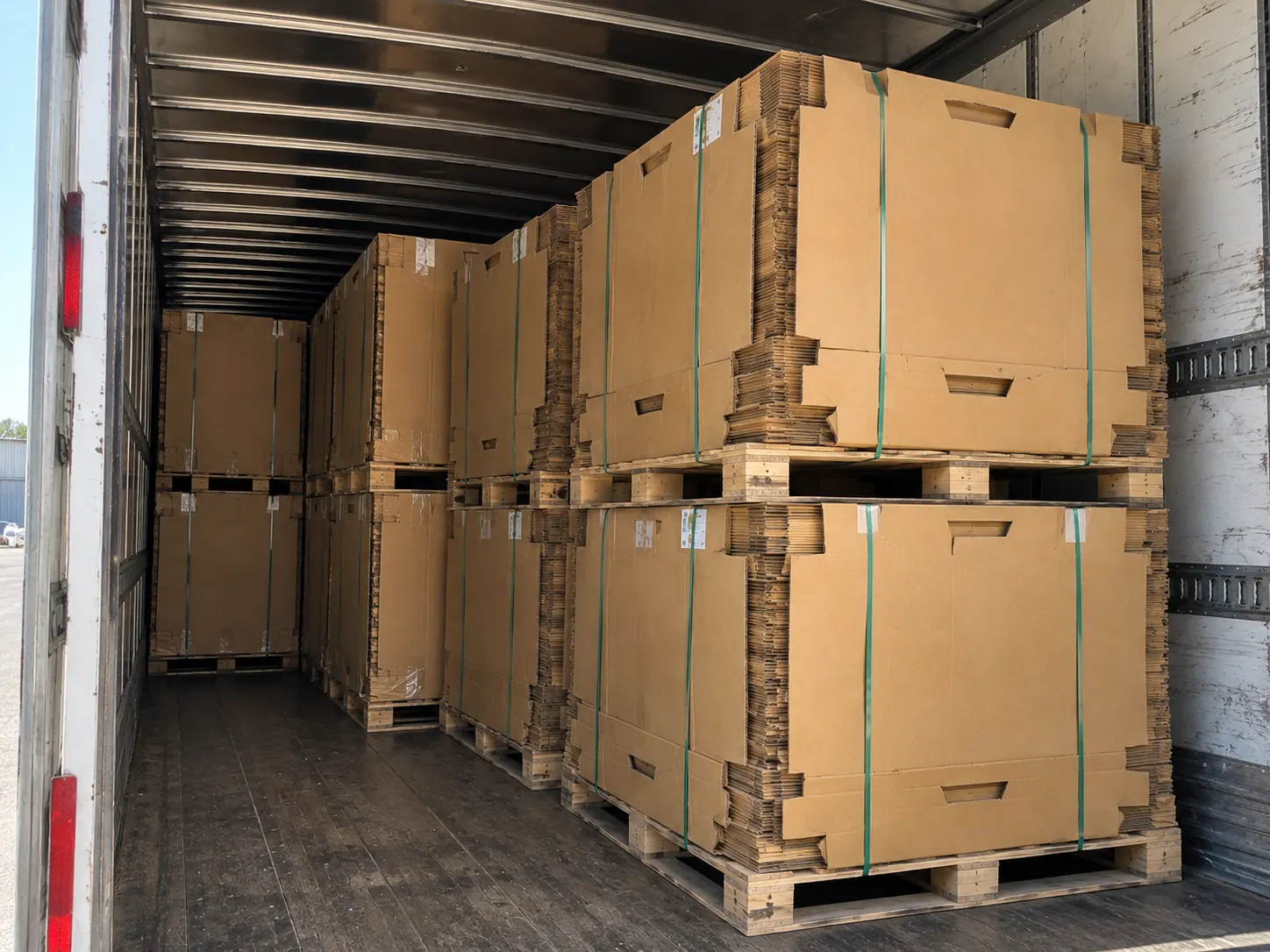
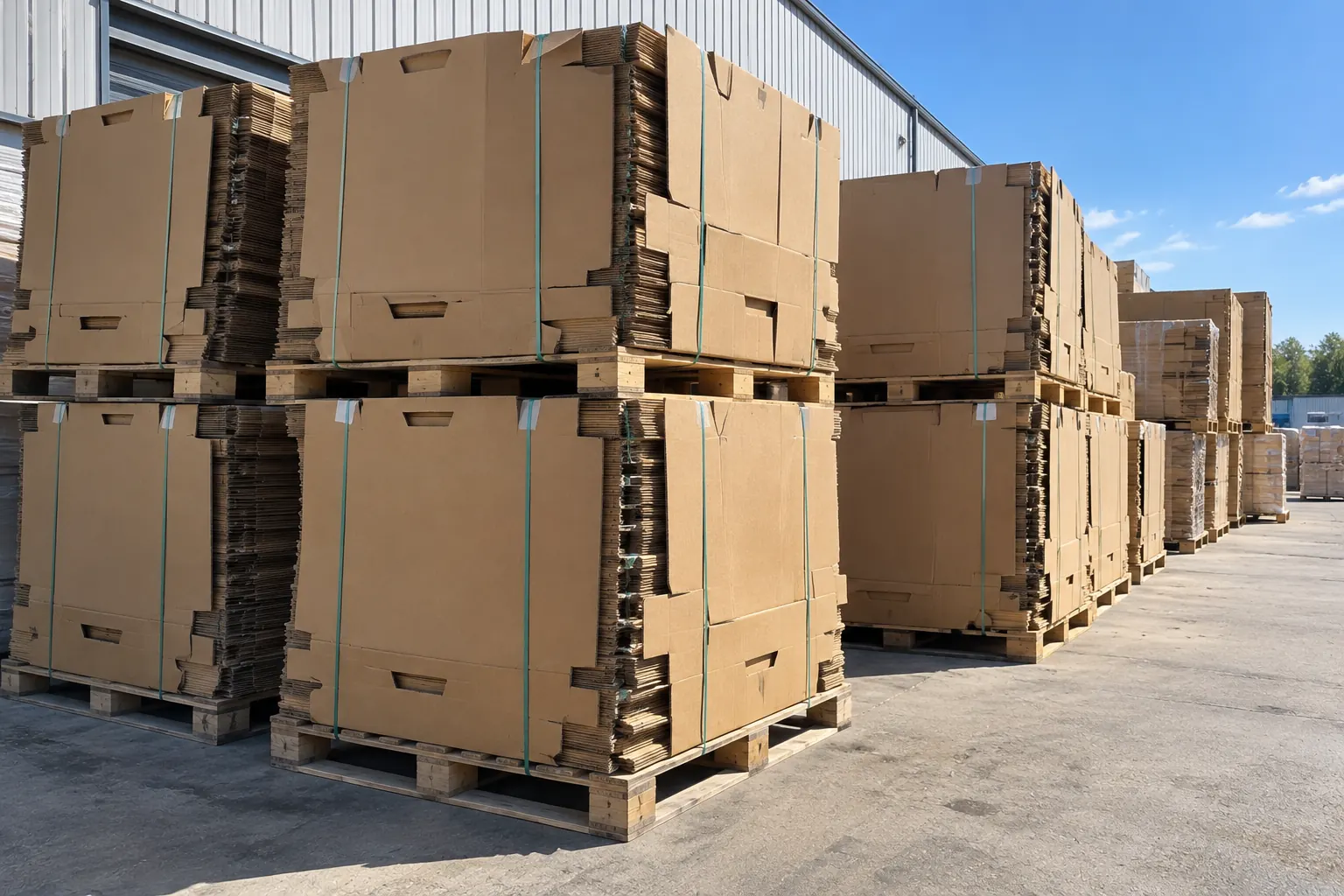
A flat gaylord takes a ninth of the space of an erected one.
That ratio — roughly 8.6 to one on a standard 48 × 40 × 36 container — is the single biggest lever on what used packaging costs delivered.
A 53-foot trailer carries 62 erected gaylords or 534 knocked down. Nothing else on an invoice can close a gap that size, which is why everything leaving Meeks Boulevard is banded flat unless you specifically ask otherwise.
The blog
Forty long-form pieces, every number with its workings.
Open 02The size chart
Dimensions, grades, flutes, pallet maths and the articles behind them.
Open 03Our story
A rented bay, a borrowed forklift, and eighteen years of grading boxes by hand.
Open 04Contact us
Address, email, hours. No phone number — and there is a reason.
Open