Used corrugated boxes
Single and double-wall shippers that already did one job well and are ready for the next five. Sorted into clean size runs so your pack line never stalls.
Quote used corrugated boxes
Give us a size and a count and we will photograph the actual pallet before you commit.
- Range
- 10" to 40" on the long side
- Styles
- RSC, FOL, HSC, one-piece folder
- Grades
- A / B / C
- Minimum
- 250 boxes or mixed pallet
- Matched size runs — not a mixed heap
- Bundled in 25s, banded, pallet-wrapped
- Label and tape residue noted per grade
- Standing weekly orders at a locked price
Work out the cube before you ask for a price.
Box Studio gives you the erected cube, the knocked-down cube, the pallet fit and the trailer count for any size — then attaches the spec to the form above.
A matched size run — which is the expensive part.
Anybody can give you a pallet of mixed used boxes. Sorting 2,000 boxes into a single size, counting them, bundling them in 25s and banding them is the work you are actually paying for, and it is what keeps a pack line moving.
Sorted by size run
One size per bundle, counted, not estimated. 'Approximately a pallet' is not a quantity.
Graded, then labelled
Each bundle carries its grade and dimensions on a band tag, so your receiving team is never guessing.
Residue noted
Tape and label residue is recorded per grade. If you are re-labelling, you need to know before the pallet arrives.
Bundled in 25s
Banded in quarter-hundreds so a line operator can count stock at a glance.
Nested where possible
Knocked down and nested for freight. We show the cube maths on the quote.
Standing orders
Weekly or monthly releases at a locked price, held in our yard until you call them.
Twelve size runs we hold most of the time.
Stock moves constantly, so treat this as the shape of our inventory rather than a live list. Ask and we will tell you what is on the floor today.
| Dimensions | Style | Wall / test | Cube | Typical use |
|---|---|---|---|---|
| 10" × 8" × 6" | RSC (0201) | Single — 32 ECT | 0.28 ft³ | Small parcel, spares, e-commerce |
| 12" × 9" × 6" | RSC (0201) | Single — 32 ECT | 0.38 ft³ | Book and media shipper |
| 12" × 12" × 6" | RSC (0201) | Single — 32 ECT | 0.50 ft³ | Shallow retail pack |
| 12" × 12" × 12" | RSC (0201) | Single — 32 ECT | 1.00 ft³ | Cube shipper, moving, retail backroom |
| 14" × 10" × 8" | RSC (0201) | Single — 32 ECT | 0.65 ft³ | General small pack line |
| 14" × 14" × 14" | RSC (0201) | Single — 32 ECT | 1.59 ft³ | Kitchenware, small appliance |
| 16" × 12" × 10" | RSC (0201) | Single — 44 ECT | 1.11 ft³ | Mid e-commerce, multi-item |
| 16" × 16" × 16" | RSC (0201) | Single — 44 ECT | 2.37 ft³ | Moving cube, lightweight bulk |
| 18" × 12" × 12" | RSC (0201) | Double — 48 ECT | 1.50 ft³ | Heavy small goods, hardware |
| 18" × 18" × 16" | RSC (0201) | Double — 48 ECT | 3.00 ft³ | General warehouse workhorse |
| 18" × 18" × 18" | RSC (0201) | Double — 48 ECT | 3.38 ft³ | Linens, lamp shades, archive |
| 18" × 18" × 24" | RSC (0201) | Double — 48 ECT | 4.50 ft³ | Tall moving box, dish pack |
| 20" × 15" × 15" | RSC (0201) | Double — 48 ECT | 2.60 ft³ | Mixed replenishment |
| 20" × 20" × 12" | RSC (0201) | Double — 48 ECT | 2.78 ft³ | Shallow bulk, trays and lids |
| 20" × 20" × 20" | RSC (0201) | Double — 48 ECT | 4.63 ft³ | Bulk picking, apparel |
| 22" × 16" × 12" | RSC (0201) | Double — 48 ECT | 2.44 ft³ | Retail case pack |
| 24" × 12" × 12" | RSC (0201) | Double — 48 ECT | 2.00 ft³ | Long goods, tubes, extrusions |
| 24" × 16" × 16" | RSC (0201) | Double — 51 ECT | 3.56 ft³ | Heavy mixed distribution |
| 24" × 18" × 18" | RSC (0201) | Double — 51 ECT | 4.50 ft³ | Book carton, heavy retail |
| 24" × 20" × 18" | FOL (0203) | Double — 51 ECT | 5.00 ft³ | Reusable internal transfer |
| 24" × 24" × 18" | RSC (0201) | Double — 51 ECT | 6.00 ft³ | Palletised bulk, four per layer |
| 24" × 24" × 24" | RSC (0201) | Double — 51 ECT | 8.00 ft³ | Furniture parts, bulk e-comm |
| 26" × 18" × 16" | FOL (0203) | Double — 51 ECT | 4.33 ft³ | Returns processing |
| 30" × 20" × 16" | RSC (0201) | Double — 51 ECT | 5.56 ft³ | Palletised retail replenishment |
| 30" × 24" × 24" | FOL (0203) | Double — 61 ECT | 10.00 ft³ | Heavy industrial, reusable |
| 36" × 24" × 18" | HSC (0204) | Double — 61 ECT | 9.00 ft³ | Tray-and-lid, open-face picking |
| 36" × 24" × 24" | HSC (0203) | Double — 61 ECT | 12.00 ft³ | Bulk bins, heavy industrial |
| 40" × 30" × 30" | FOL (0409) | Triple — 71 ECT | 20.83 ft³ | Machine parts, export crating |
| 44" × 36" × 30" | Bulk bin (0310) | Triple — 71 ECT | 27.50 ft³ | Sub-pallet bulk, heavy assemblies |
| 48" × 40" × 36" | Bulk bin (0310) | Triple — 1,100 lb test | 40.00 ft³ | Gaylord replacement, agriculture |
The word “used” means four different things.
So we stopped using it on its own. Drag the lens: this is exactly what you are choosing between when you pick a grade on a quote.
- Grade A for retail-facing and export lanes
- Grade B for everyday internal logistics — our core volume
- Grade C for one-way moves, scrap collection and in-plant totes
- Mixed loads priced as mixed loads, never dressed up as grade B
Grade B — Good, light wear
Minor surface scuffs, light creasing on one panel, clean interior. All flaps intact and fully functional.
The nine points, in the order a grader checks them.
Ordered by how well each point predicts failure under load, not by how obvious it is. The first one is the least visible and the most important.
| # | What is checked | What disqualifies | Downgrades to |
|---|---|---|---|
| 1 | Bottom third of the long panel | Soft, fuzzed or delaminated board from tine strikes | Recovery |
| 2 | Vertical corner squareness | Corners bowed outward from over-stuffing | C, or recovery if severe |
| 3 | Liner colour banding | Patchy darkening indicating moisture cycling | Recovery |
| 4 | Flap edge condition | Fuzzed or feathered edges; missing flap corners | C, or bench repair |
| 5 | Score line integrity | Cracked rather than creased folds | C, or bench re-score |
| 6 | Manufacturer's joint | Separated glue line or pulled staples | Bench repair |
| 7 | Interior cleanliness | Residue, dust, previous product traces | C |
| 8 | Print and label residue | Heavy multi-colour print or continuous tape bands | B at best; re-face station |
| 9 | Top edge crush | Crushing on stacked or racked units | Bench reinforcement, else C |
The strength you lose, and never get back.
Board that has been to 20% moisture and dried back to 9% does not recover its original strength. The damage is permanent and invisible — the box looks fine and fails at a load it used to carry.
| Moisture content | Edge crush retained | What it means | What we do |
|---|---|---|---|
| 6 – 8% | 100% | Specification condition, as tested at the mill | Nothing |
| 10% | ~90% | Normal conditioned warehouse | Nothing |
| 12% | ~80% | Noticeable softening; stacking margin eroding | Reduce stack height |
| 15% | ~60% | Do not stack; one more cycle at best | Grade down to C |
| 18% | ~45% | Structural life effectively over | Bench or baler |
| 20%+ | ~35% | Finished, even after drying back | Baler |
Six things move the number, and volume is only the fourth.
Used box pricing confuses people because the obvious lever — how many you want — is among the weakest of the six. Spread is the gap between best and worst case on our own quote data.
| Factor | Spread | Why |
|---|---|---|
| Destination lane | 2.8× | Within-Midwest versus a long nationwide haul |
| Size-run consistency | 2.1× | A single matched size versus genuinely mixed sizes |
| Grade | 1.9× | Grade C versus grade A on the same size |
| Order volume | 1.3× | One pallet versus a full truckload, same lane and grade |
| Timing flexibility | 1.15× | Take-it-when-it-lands versus a fixed delivery date |
| Season | 1.1× | March versus October on the same lane |
Supply and demand move in opposite directions for most of the year.
If you buy on a fixed monthly schedule you are riding across this blind. It is a pattern rather than a law — but there is a calendar, and most buyers do not know it exists.
| Period | Inbound supply | Outbound demand | Practical effect |
|---|---|---|---|
| January – February | Very high | Low | Best availability and price of the year |
| March – April | High | Moderate | Good availability; grade A plentiful |
| May – June | Moderate | Moderate | Balanced; agriculture starts pulling gaylords |
| July – August | Low | High | Tightening; lead times extend |
| September – October | Low | Very high | Tightest of the year |
| November – December | Rising | Falling | Availability recovers, grade quality dips |
Sorting is the product
The board costs us very little. Somebody was paying to throw it away, which is the whole origin of this business. What costs money is turning a heap into a matched size run: grading each box by hand, counting rather than estimating, bundling in twenty-fives, banding, and labelling the bundle with size, style and grade.
Which is why a single matched size prices so differently from nine mixed ones, and why volume is a weaker lever than most buyers expect. Consolidating your size list is usually worth more than any discount you will negotiate.
Why a used box no longer meets its printed certificate
Look inside almost any shipper and there is a round stamp — the Box Maker's Certificate — carrying a Mullen or ECT rating. On a used container that stamp is a historical document. The board has been loaded, stacked, trucked and cycled through humidity changes. Flutes have taken a set, scores have softened, and the liner has absorbed and released moisture.
We grade on observed condition against a written four-point scale instead, and we say so on every quote. A supplier quoting the original rating on used board is either being careless or hoping you will not notice.
Where used board is the wrong answer
- Direct food contact. No used container is suitable, and no certificate changes that. Use a lined container instead.
- Anything requiring a documented, certified performance rating for a carrier claim.
- Cleanroom and particulate-controlled environments.
- Retail-facing packaging where the box is the brand and print has to be perfect.
- Archive storage with a multi-decade horizon, where you want known board and known adhesive.
In each of those we will quote new board with high recycled content and tell you why. For everything else — internal moves, pack lines, distribution, bulk, scrap collection — graded used board does the same job for roughly a third of the price and about a ninth of the carbon.
Six ways to cut what you spend without cutting quality.
In rough order of impact. None of these involve negotiating a lower price per box.
Consolidate sizes
Going from nine sizes to four is normally worth more than doubling the order, because it removes our largest cost rather than squeezing our margin.
Grade by application
Grade A for customer-facing, B for everything that stacks, C for one-way moves and scrap collection. Most sites buy one grade for all three.
Widen the delivery window
Three days instead of a fixed date lets us consolidate. On low-density freight that is real money.
Take a standing order
Truckload freight economics on LTL-sized consumption, with the balance held in our yard.
Buy in Q1
Supply peaks in January and February while demand is at its lowest. Best availability and best grade mix of the year.
Sell us your empties
If anything leaves your building flat or baled, about 18% of it is still a container. That is a credit against your next order.
The liners and mediums underneath every box.
Board specification starts one level below the box: which liner, which medium, at what basis weight. Basis weight is stated in pounds per thousand square feet.
| Grade | Basis weight | Fibre | Typical use | Note |
|---|---|---|---|---|
| Kraft liner 26# | 26 lb/MSF | Virgin kraft | Light single wall | Lowest practical outer liner |
| Kraft liner 33# | 33 lb/MSF | Virgin kraft | Standard 32 ECT outer | The commonest liner in North America |
| Kraft liner 42# | 42 lb/MSF | Virgin kraft | 44 ECT and double wall | Noticeably stiffer, better print |
| Kraft liner 69# | 69 lb/MSF | Virgin kraft | Triple wall outer | Gaylord-grade facing |
| Test liner 2 | 27 – 50 lb/MSF | ≥ 80% recycled | General shipper | Most recycled-content board |
| Test liner 3 | 27 – 50 lb/MSF | 100% recycled | Internal and bulk | Lower burst for the same weight |
| Mottled white | 35 – 42 lb/MSF | Mixed | Retail-facing print | White outer, kraft back |
| Semi-chem medium 26# | 26 lb/MSF | Semi-chemical | Standard flute medium | Highest stiffness per weight |
| Recycled medium 23# | 23 lb/MSF | 100% recycled | Economy flute medium | Common in test-liner board |
| Type | Where it is used | Water resistance | Recycling | Note |
|---|---|---|---|---|
| Starch (corrugating) | Liner to medium | Low resistance | Ideal | The standard bond in all corrugated board |
| Hot melt EVA | Manufacturer's joint, cases | Moderate | Tolerated | Fast set; brittle when cold |
| Cold-set PVA | Case sealing | Low | Ideal | Slow set, strong fibre tear |
| Water-resistant starch | Produce board | High | Good | Alternative to wax for damp environments |
| Pressure-sensitive | Tape, labels | Varies | Tolerated in small amounts | Residue downgrades grade A board |
| Stitching (staples) | Manufacturer's joint | Unaffected | Removed in the junk trap | Outlasts glue through reuse cycles |
Seven ways to put a mark on a box.
Ranked roughly by setup cost. The last two are what we use on recovered board — removing somebody else's brand is a different job from applying your own.
| Method | Setup cost | Quality | Recyclability | Use | Lead time |
|---|---|---|---|---|---|
| Flexographic, 1 colour | Low | Basic | Fully | Identification, logistics marks | 3 – 7 days |
| Flexographic, 2 – 4 colour | Medium | Good | Fully | Brand on shipper | 10 – 15 days |
| High-graphic flexo | High | Very good | Fully | Retail-ready packaging | 15 – 20 days |
| Litho-lamination | Very high | Photographic | Reduced | Premium retail display | 20 – 30 days |
| Digital inkjet | None | Good | Fully | Short runs, versioning | 3 – 10 days |
| Blank-out over-print | None | Functional | Fully | Removing a previous owner's brand | Same day |
| Stencil | None | Industrial | Fully | Pool container marking | Same day |
How long each thing actually takes.
Measured from a confirmed order, not from the first email. Artwork approval and procurement onboarding sit outside these figures and are usually the real critical path.
| Item | Lead time | Note |
|---|---|---|
| Graded used shippers, stock size | Same week | Often 48 hours on Midwest lanes |
| Graded gaylords, stock size | Same week | Knocked down and banded |
| Reconditioned gaylords | 7 – 10 days | Bench time plus re-grading |
| Lids, liners and accessories | Same week | Ships on the same pallet |
| Recovered pallets, repaired | 3 – 7 days | Depends on repair queue |
| New stock-size boxes | 2 – 5 days | 60+ sizes held in St. Louis |
| New custom die | 10 – 15 working days | Includes die making and first article |
| Printed new board, 1 – 4 colour | 10 – 15 working days | Plate making included |
| Honeycomb panel, stock | 5 days | Pressed from recovered board |
| Die-cut dunnage to profile | 7 – 10 days | Tooling for non-standard profiles adds time |
| Printed retail display | 10 – 12 days | Artwork approval is usually the critical path |
| Baler placement | 2 – 4 weeks | Site survey, delivery and commissioning |
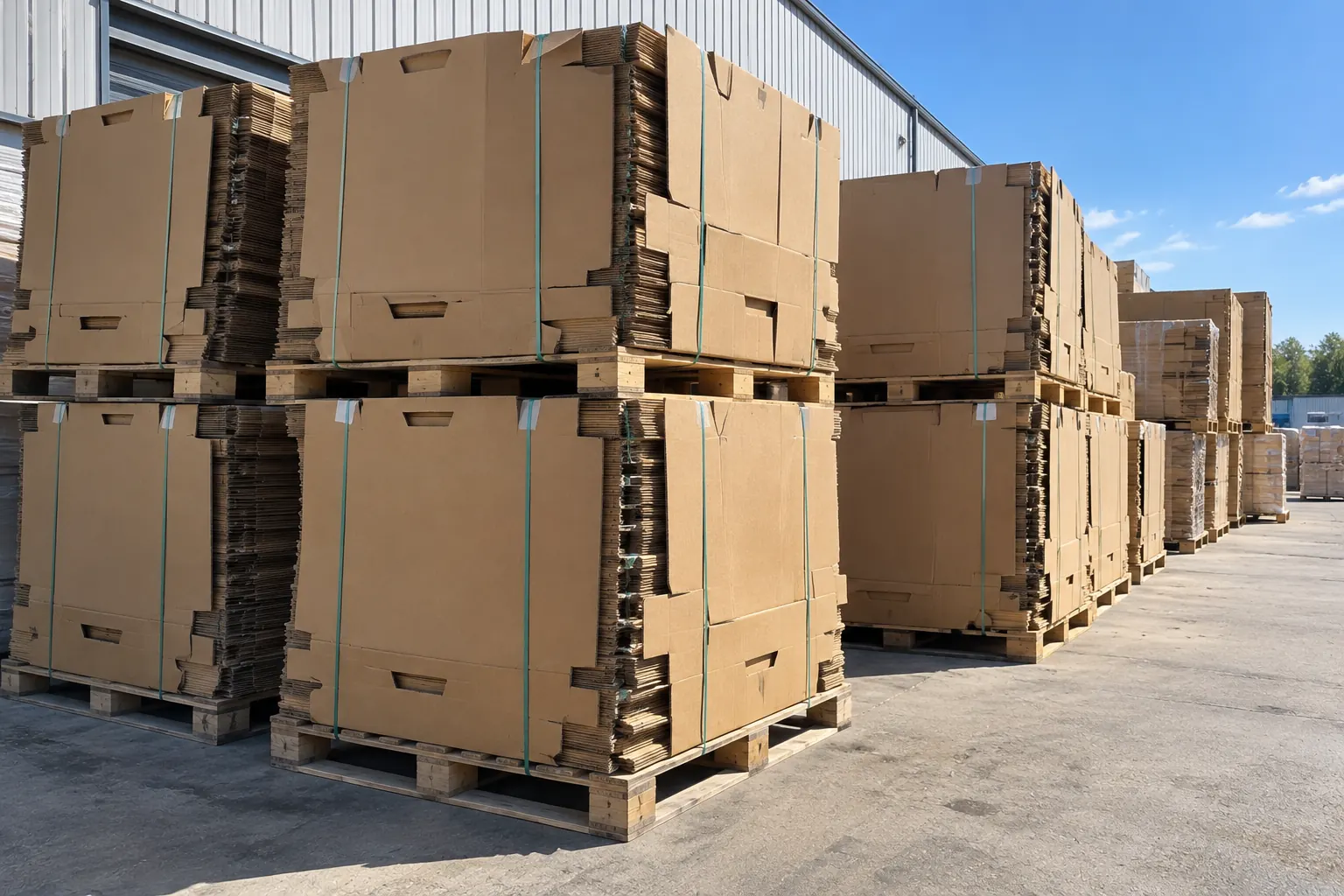
Anybody can sell you a heap. A matched size run is the work.
A grader handling a single size run processes a pallet in about nine minutes. The same grader splitting a mixed heap into nine size buckets, counting each, bundling in twenty-fives and banding takes closer to forty.
Same board, same weight, four times the labour — which is why consolidating your size list is usually worth more than any discount you will negotiate.