Everything we know about box dimensions, on one page.
Ten sections, nine tables and the arithmetic we actually use on the grading floor. If you only read one thing here, read 'How to measure' — it is the source of most of the mistakes we see.
Ask about a size
Give us a dimension even if you are not sure it is right. We will correct it with you.
Straight to the grading floor at 9869 Meeks Blvd, St. Louis, MO 63132.
Or email sales@reboxesmarket.com. We have no phone line — dimensions and counts survive much better in writing.
Not sure of the size?
Fold a box in the browser, read off the cube and pallet fit, and send the spec straight through.
1 · How to measure a box
Corrugated is always stated as length × width × height, and always as inside dimensions. Those two conventions cause almost every sizing error we see.
- Length is the longer of the two dimensions of the open face.
- Width is the shorter dimension of the open face.
- Height is measured from the open face down, perpendicular to length and width.
Inside dimensions matter because that is what your product has to fit into. Outside dimensions matter for pallet fit and trailer cube. The difference is the board thickness: roughly 1/8" per wall for single, 5/16" for double and 5/8" for triple. On a 48-inch gaylord that is well over an inch — enough to turn a flush pallet fit into an overhang.
And measure the pallet, not the standard
A “48 × 40 GMA pallet” in real life is anywhere from 47.5 to 48.5 inches wide depending on age, repairs and manufacturer. If your container is specified flush to 48 inches, half of your pallets will give you an overhang. Spec to the pallets on your floor.
Or let the browser do it
Box Studio converts dimensions into cube, blank area, pallet fit and trailer count instantly, and shows the die-line.
Ten footprints we hold in graded stock.
Capacity figures assume an even load, a separate lid and strapping. Dense material should go in a low-side box rather than a tall one.
| Name | Dimensions | Wall | Capacity | Cube | Typical use | Grades held |
|---|---|---|---|---|---|---|
| Standard 48 | 48" × 40" × 36" | Triple wall | 1,800 – 2,200 lb | 40.0 ft³ | General bulk, OCC collection | A / B |
| Low-side 48 | 48" × 40" × 30" | Triple wall | 1,600 – 2,000 lb | 33.3 ft³ | Dense scrap, metal turnings | A / B |
| Mid 48 | 48" × 40" × 34" | Triple wall | 1,800 lb | 37.8 ft³ | Automotive parts, castings | B |
| Tall-standard 48 | 48" × 40" × 39" | Triple wall | 1,900 lb | 43.3 ft³ | Mixed distribution bulk | A / B |
| Tall 48 | 48" × 40" × 44" | Triple wall | 1,800 – 2,200 lb | 48.9 ft³ | Textiles, foam, light bulk | A / B / C |
| Extra-tall 48 | 48" × 40" × 48" | Triple wall | 2,000 – 2,400 lb | 53.3 ft³ | Returns processing, apparel | B / C |
| Column 48 | 48" × 40" × 52" | Triple wall + corner posts | 2,000 lb | 57.8 ft³ | Light, high-cube consolidation | B |
| Harvest 48 | 48" × 40" × 60" | Triple wall + liner | 2,200 lb | 66.7 ft³ | Hemp, tobacco, light agriculture | A |
| Wide 48 | 48" × 44" × 36" | Triple wall | 2,000 lb | 44.0 ft³ | Produce, agricultural bulk | A / B |
| Produce 48 | 48" × 45" × 34" | Triple wall, vented | 1,900 lb | 42.5 ft³ | Field-pack produce with ventilation | A |
| Pallet-flush 40 | 40" × 48" × 40" | Double wall | 1,200 – 1,500 lb | 44.4 ft³ | Light consolidation | B |
| Octabin 41 | 41" × 41" × 45" | Double / triple wall (8-sided) | 2,000 – 2,800 lb | 43.7 ft³ | Resin pellets, powders, free-flow | A / B |
| Octabin 41 | 41" × 41" × 38" | Triple wall (8-sided) | 2,400 lb | 36.9 ft³ | Dense granulate, minerals | A / B |
| Tall octabin | 41" × 41" × 53" | Double wall (8-sided) | 2,000 lb | 51.5 ft³ | Low-density powders, flake | B |
| Compact 36 | 36" × 36" × 36" | Double wall | 900 – 1,200 lb | 27.0 ft³ | Half-pallet bulk, e-comm returns | B / C |
| Compact tall | 36" × 36" × 45" | Double wall | 1,000 lb | 33.8 ft³ | Retail backroom consolidation | B / C |
| Half-pallet 32 | 32" × 30" × 36" | Double wall | 800 lb | 20.0 ft³ | Store-level display and bulk | B |
| Mini bulk | 30" × 30" × 30" | Double wall | 700 lb | 15.6 ft³ | Samples, kitting, shop floor | B |
| Quarter bin | 24" × 20" × 21" | Double wall | 350 lb | 5.8 ft³ | In-plant totes, work-in-progress | B / C |
| Shallow 48 | 48" × 40" × 24" | Triple wall | 1,500 lb | 26.7 ft³ | Very dense scrap, swarf, offcuts | A / B |
Twelve stock runs, and what each is for.
Stock turns constantly. Treat this as the shape of our inventory rather than a live list.
| Dimensions | Style | Wall / test | Cube | Typical use |
|---|---|---|---|---|
| 10" × 8" × 6" | RSC (0201) | Single — 32 ECT | 0.28 ft³ | Small parcel, spares, e-commerce |
| 12" × 9" × 6" | RSC (0201) | Single — 32 ECT | 0.38 ft³ | Book and media shipper |
| 12" × 12" × 6" | RSC (0201) | Single — 32 ECT | 0.50 ft³ | Shallow retail pack |
| 12" × 12" × 12" | RSC (0201) | Single — 32 ECT | 1.00 ft³ | Cube shipper, moving, retail backroom |
| 14" × 10" × 8" | RSC (0201) | Single — 32 ECT | 0.65 ft³ | General small pack line |
| 14" × 14" × 14" | RSC (0201) | Single — 32 ECT | 1.59 ft³ | Kitchenware, small appliance |
| 16" × 12" × 10" | RSC (0201) | Single — 44 ECT | 1.11 ft³ | Mid e-commerce, multi-item |
| 16" × 16" × 16" | RSC (0201) | Single — 44 ECT | 2.37 ft³ | Moving cube, lightweight bulk |
| 18" × 12" × 12" | RSC (0201) | Double — 48 ECT | 1.50 ft³ | Heavy small goods, hardware |
| 18" × 18" × 16" | RSC (0201) | Double — 48 ECT | 3.00 ft³ | General warehouse workhorse |
| 18" × 18" × 18" | RSC (0201) | Double — 48 ECT | 3.38 ft³ | Linens, lamp shades, archive |
| 18" × 18" × 24" | RSC (0201) | Double — 48 ECT | 4.50 ft³ | Tall moving box, dish pack |
| 20" × 15" × 15" | RSC (0201) | Double — 48 ECT | 2.60 ft³ | Mixed replenishment |
| 20" × 20" × 12" | RSC (0201) | Double — 48 ECT | 2.78 ft³ | Shallow bulk, trays and lids |
| 20" × 20" × 20" | RSC (0201) | Double — 48 ECT | 4.63 ft³ | Bulk picking, apparel |
| 22" × 16" × 12" | RSC (0201) | Double — 48 ECT | 2.44 ft³ | Retail case pack |
| 24" × 12" × 12" | RSC (0201) | Double — 48 ECT | 2.00 ft³ | Long goods, tubes, extrusions |
| 24" × 16" × 16" | RSC (0201) | Double — 51 ECT | 3.56 ft³ | Heavy mixed distribution |
| 24" × 18" × 18" | RSC (0201) | Double — 51 ECT | 4.50 ft³ | Book carton, heavy retail |
| 24" × 20" × 18" | FOL (0203) | Double — 51 ECT | 5.00 ft³ | Reusable internal transfer |
| 24" × 24" × 18" | RSC (0201) | Double — 51 ECT | 6.00 ft³ | Palletised bulk, four per layer |
| 24" × 24" × 24" | RSC (0201) | Double — 51 ECT | 8.00 ft³ | Furniture parts, bulk e-comm |
| 26" × 18" × 16" | FOL (0203) | Double — 51 ECT | 4.33 ft³ | Returns processing |
| 30" × 20" × 16" | RSC (0201) | Double — 51 ECT | 5.56 ft³ | Palletised retail replenishment |
| 30" × 24" × 24" | FOL (0203) | Double — 61 ECT | 10.00 ft³ | Heavy industrial, reusable |
| 36" × 24" × 18" | HSC (0204) | Double — 61 ECT | 9.00 ft³ | Tray-and-lid, open-face picking |
| 36" × 24" × 24" | HSC (0203) | Double — 61 ECT | 12.00 ft³ | Bulk bins, heavy industrial |
| 40" × 30" × 30" | FOL (0409) | Triple — 71 ECT | 20.83 ft³ | Machine parts, export crating |
| 44" × 36" × 30" | Bulk bin (0310) | Triple — 71 ECT | 27.50 ft³ | Sub-pallet bulk, heavy assemblies |
| 48" × 40" × 36" | Bulk bin (0310) | Triple — 1,100 lb test | 40.00 ft³ | Gaylord replacement, agriculture |
| Build | Construction | Strength rating | Stacking | In practice |
|---|---|---|---|---|
| Single wall | One fluted medium between two liners | 32 – 44 ECT | Up to 65 lb | The everyday shipper. Lightest, cheapest, most recyclable. |
| Double wall | Two fluted mediums, three liners | 48 – 61 ECT | Up to 120 lb | The workhorse of reuse — survives six to twelve trips with care. |
| Triple wall | Three fluted mediums, four liners | 67 – 82 ECT / 1,100 lb test | 1,200 – 2,400 lb | Gaylord territory. Replaces wooden crates on many lanes. |
| Triple wall + corner posts | Triple wall with laminated vertical posts | Beyond standard ECT scale | 3,000 lb + | Where the alternative is steel. Rare, expensive, very long-lived. |
The wave inside the board does most of the work.
Flute height decides cushioning, crush resistance and how well the surface takes print. Changing flute is often cheaper and more effective than stepping up the wall.
| Flute | Approx. thickness | Density | Character |
|---|---|---|---|
| A | ≈ 3/16" | 33 flutes/ft | Highest cushioning and stacking strength; bulky, poor print. |
| B | ≈ 1/8" | 47 flutes/ft | Crush resistant, great for canned goods and printing. |
| C | ≈ 11/64" | 39 flutes/ft | The default compromise — most RSC shippers in the US. |
| E | ≈ 1/16" | 90 flutes/ft | Thin, crisp print surface; retail and subscription boxes. |
| F | ≈ 1/32" | 128 flutes/ft | Micro-flute for small, premium primary packaging. |
| N | ≈ 1/64" | 200+ flutes/ft | Nano-flute; folding-carton replacement, rarely seen in reuse. |
| BC | ≈ 5/16" | Double wall | B + C combined — the common double-wall build. |
| EB | ≈ 3/16" | Double wall | Thin, stiff, excellent print. Retail rather than logistics. |
| AC | ≈ 23/64" | Double wall | Maximum cushioning double wall; bulky and uncommon. |
| BCA | ≈ 1/2" | Triple wall | Gaylord territory. 1,100 lb test and crate replacement. |
| Code | Name | Note |
|---|---|---|
| 0110 | Commercial sheet | Flat board, not a container. Layer pads, slip sheets, dunnage blanks. |
| 0200 | SSC — Slotted container, single flap | One set of flaps only. Rare, used as a tray body. |
| 0201 | RSC — Regular Slotted Container | Flaps meet in the middle. 90% of what moves through our yard. |
| 0202 | OSC — Overlap Slotted Container | Outer flaps overlap by an inch or so. Extra edge stiffness, cheap. |
| 0203 | FOL — Full Overlap | Outer flaps fully overlap for edge strength. The best style for reuse. |
| 0204 | HSC — Half Slotted Container | One open end, used as a tray or with a separate lid. |
| 0206 | SFF — Full telescope, two pieces | Two half-slotted containers, one inverted over the other. |
| 0209 | CSSC — Centre special slotted | Flaps of unequal length meeting off-centre. Awkward products. |
| 0300 | Telescope, separate top and bottom | Two trays. Common in produce and retail-ready packaging. |
| 0301 | Full telescope design box | Lid covers the whole body. Heavy-duty, very reusable. |
| 0306 | Tray and lid | Separate shallow lid over a deeper tray. Shelf-ready. |
| 0310 | Telescoping bulk bin | Body plus separate cap — the classic gaylord with a lid. |
| 0320 | Partial telescope with cover | Shallow cap for dust rather than structure. |
| 0330 | Double cover bulk bin | Separate top and bottom caps. Maximum container life. |
| 0402 | Folder with dust flaps | One blank folded around the product; dust flaps close the ends. |
| 0406 | Book wrap / mailer | Self-locking wrap for flat goods. Single-trip by nature. |
| 0409 | One-piece folder | Flat blank folded around the product. Books, print, apparel. |
| 0427 | Roll-end tuck-top mailer | Retail-facing e-commerce mailer. Good print surface. |
| 0501 | Sleeve | Open both ends, slides over an inner container. |
| 0601 | Rigid set-up box | Body plus two separate end pieces. Niche industrial use. |
| 0771 | Octabin / octagonal bulk | Eight-sided bulk container for free-flowing material. |
| 0900 | Interior fitments | Partitions, dividers, pads, inserts. Made to the product, not the box. |
| Pallet | Box | Per layer | Layers | Note |
|---|---|---|---|---|
| 48" × 40" GMA | 48" × 40" × 36" gaylord | 1 | 1 | Flush footprint. 20 – 24 per 53' trailer, knocked down: 400+. |
| 48" × 40" GMA | 24" × 20" × 18" | 4 | 2 | Interlock alternating layers for stability. |
| 48" × 40" GMA | 24" × 16" × 16" | 5 | 3 | Two long plus three short; leaves a small void. |
| 48" × 40" GMA | 20" × 20" × 20" | 4 | 3 | Column stack; 8" overhang-free margin on the long axis. |
| 48" × 40" GMA | 18" × 18" × 18" | 5 | 3 | Pinwheel with a centre void. 15 per pallet. |
| 48" × 40" GMA | 16" × 16" × 16" | 6 | 3 | Flush footprint, no overhang; stretch-wrap recommended. |
| 48" × 40" GMA | 14" × 14" × 14" | 9 | 4 | Three by three, slight void each side. |
| 48" × 40" GMA | 12" × 12" × 12" | 13 | 4 | Pinwheel pattern; 52 boxes per pallet. |
| 48" × 40" GMA | 12" × 9" × 6" | 17 | 8 | Brick pattern; count carefully, this one is easy to get wrong. |
| 48" × 48" drum | 41" × 41" × 45" octabin | 1 | 1 | Single bin per pallet; strap to deck. |
| 48" × 48" drum | 24" × 24" × 24" | 4 | 2 | Perfect flush fit, column stacked. |
| 42" × 42" | 20" × 20" × 20" | 4 | 2 | Common beverage footprint. |
| 48" × 45" produce | 48" × 45" × 34" | 1 | 1 | Field-pack bin, vented, flush. |
| 44" × 44" | 22" × 22" × 20" | 4 | 3 | Flush; popular in chemical distribution. |
| 36" × 36" half | 18" × 18" × 18" | 4 | 3 | Half-pallet display base. |
| 1200 × 1000 mm | 600 × 400 × 400 mm | 5 | 3 | Metric euro-equivalent; the closest to a GMA pattern. |
| Grade | Means | Condition | Typically used for | Price band |
|---|---|---|---|---|
| A | Like new | Used once, no print bleed-through, square corners, no scuffing on flaps. Often a single-trip freight box or an over-run that never shipped. | Direct resale, retail-facing, export | Premium |
| B | Good, light wear | Minor surface scuffs, light creasing on one panel, clean interior. All flaps intact and fully functional. | Internal logistics, bulk shipping, storage | Core value |
| C | Usable, visible wear | Visible creasing, labels or tape residue, possible small tears away from load-bearing edges. Still holds a stack. | Scrap collection, in-plant totes, one-way moves | Volume |
| D | Recovery only | Delaminated, crushed flutes or moisture-stained. We bale these as OCC rather than resell them. | Baled OCC → paper mill | Commodity |
Six formulas we use every day.
None of these are difficult. All of them are regularly got wrong, usually by a factor of 1,728.
| You want | Formula | Worked example |
|---|---|---|
| Cube in ft³ | (L × W × H) ÷ 1,728 | 48 × 40 × 36 ÷ 1,728 = 40.0 ft³ |
| RSC blank area in in² | (2L + 2W + tab) × (H + W) | (96 + 80 + 2) × (36 + 40) = 13,528 in² |
| Board weight in lb | (blank in² ÷ 144) × lb per ft² | 13,528 ÷ 144 × 0.55 = 51.7 lb |
| Knocked-down cube in ft³ | (blank in² × caliper) ÷ 1,728 | 13,528 × 0.6 ÷ 1,728 = 4.70 ft³ |
| Boxes per pallet layer | max of the two orientations on the deck | floor(48÷24) × floor(40÷20) = 4 |
| Boxes per 53′ trailer | (3,489 × 0.72) ÷ cube per box | 2,512 ÷ 4.70 = 534 knocked down |
The last two lines are the whole argument for knocking boxes down: the same trailer carries 62 erected 48 × 40 × 36 gaylords, or 534 of them flat.
Seven sizing errors we see every month.
Quoting outside dimensions as inside
The most common error by a wide margin. A 48-inch outside triple-wall box has a 46.75-inch inside dimension. If your product is 47 inches, it will not fit, and nobody will discover that until a trailer arrives.
Putting height first
Corrugated convention is L × W × H, with height measured from the open face. Stating 36 × 48 × 40 for a standard gaylord is understood by nobody and will get you a box that is the wrong shape.
Specifying flush to the pallet standard
Real GMA pallets vary from 47.5" to 48.5". A container specified at exactly 48 inches will overhang on half of them, and an overhanging container gets damaged in every rack move.
Ignoring the top score line
Filling above the top score permanently rounds the corners and ends stackability. If your volume needs the extra two inches, buy the taller box rather than over-filling the short one.
Converting ECT to Mullen as if it were exact
The equivalence tables are rules of thumb from an era when carriers specified Mullen. They are conversational, not contractual. Decide which test your application actually needs.
Assuming a used box still meets its printed certificate
It does not. Flutes have taken a set and scores have softened. We grade on observed condition; the Box Maker's Certificate is a historical document at that point.
Forgetting the lid in the stack height
A telescoping lid adds 2 – 3 inches. Four containers that fit a 60-inch clearance unlidded will not fit lidded, and the rack beam does not negotiate.
Mullen and ECT, side by side.
Two tests measuring two different failure modes. The equivalences below exist because carriers historically specified Mullen — treat them as conversational rather than contractual, and pick the test that matches how your boxes actually fail.
| Mullen (burst) | ECT (stacking) | Wall | Max size sum | Max gross weight | Typical use |
|---|---|---|---|---|---|
| 125 lb | 23 ECT | Single | 40" | 20 lb | Light retail, folding-carton replacement |
| 150 lb | 26 ECT | Single | 60" | 40 lb | Small parcel, light goods |
| 175 lb | 29 ECT | Single | 65" | 50 lb | General light shipper |
| 200 lb | 32 ECT | Single | 75" | 65 lb | The standard single-wall shipper |
| 250 lb | 40 ECT | Single | 85" | 80 lb | Heavier single wall |
| 275 lb | 44 ECT | Single | 95" | 95 lb | Top of the single-wall range |
| 275 lb | 48 ECT | Double | 100" | 120 lb | Entry double wall — the reuse workhorse |
| 350 lb | 51 ECT | Double | 110" | 180 lb | Heavy distribution |
| 400 lb | 55 ECT | Double | 120" | 225 lb | Industrial parts |
| 500 lb | 61 ECT | Double | 140" | 260 lb | Heavy double wall, bulk bins |
| 600 lb | 67 ECT | Triple | 160" | 300 lb | Entry triple wall |
| 700 lb | 71 ECT | Triple | 165" | 600 lb | Export crating replacement |
| 900 lb | 77 ECT | Triple | 170" | 1,200 lb | Heavy bulk bins |
| 1,100 lb | 82 ECT | Triple | 180" | 2,400 lb static | Gaylord standard |
“Max size sum” is length plus width plus depth. Exceeding it voids the certification even if the box is physically capable, which matters in a freight claim.
What a square foot of each build actually weighs.
The number you need to turn a die-line area into a shipping weight, a carbon figure or a freight class. Multiply blank area in square feet by the figure below.
| Construction | lb per ft² | lb per MSF | Caliper | Note |
|---|---|---|---|---|
| Single wall, 32 ECT (C flute) | 0.20 | 200 | 0.16" | Lightest practical shipper |
| Single wall, 44 ECT (C flute) | 0.24 | 240 | 0.17" | Heavier liner, same flute |
| Double wall, 48 ECT (BC) | 0.33 | 330 | 0.30" | The reuse workhorse |
| Double wall, 61 ECT (BC) | 0.40 | 400 | 0.32" | Heavy distribution |
| Triple wall, 71 ECT | 0.48 | 480 | 0.52" | Crate replacement |
| Triple wall, 1,100 lb test | 0.55 | 550 | 0.60" | Gaylord standard |
| Honeycomb panel, 1" | 0.35 – 0.60 | — | 1.00" | Dunnage and display substrate |
Ten conversions we use every day.
None of these are difficult. All of them are regularly got wrong, usually by a factor of 1,728.
| From | To | Factor | Worked example |
|---|---|---|---|
| Cubic inches | Cubic feet | ÷ 1,728 | 48 × 40 × 36 = 69,120 in³ = 40.0 ft³ |
| Square inches | Square feet | ÷ 144 | 13,528 in² = 93.9 ft² |
| Pounds per ft² | Board weight | × area in ft² | 93.9 ft² × 0.55 = 51.7 lb |
| Pounds | Kilograms | × 0.45359 | 51.7 lb = 23.5 kg |
| Inches | Millimetres | × 25.4 | 48" = 1,219 mm |
| Cubic feet | Cubic metres | × 0.02832 | 40.0 ft³ = 1.13 m³ |
| Short tons | Metric tonnes | × 0.90718 | 11,800 tons = 10,705 tonnes |
| Loose OCC volume | Weight | × 80 lb/yd³ | 40 yd³ ≈ 3,200 lb |
| Baled OCC volume | Weight | × 700 lb/yd³ | 2 yd³ bale ≈ 1,400 lb |
| Trailer volume (53') | Usable | × 0.72 | 3,489 ft³ → 2,512 ft³ |
What actually fits in the truck.
Every cube figure we quote is calculated against these, at a realistic 72% packing efficiency rather than a theoretical 100%.
| Unit | Inside dimensions | Volume | Pallet positions | Payload | Note |
|---|---|---|---|---|---|
| 53' dry van | 630" × 100" × 110" | 3,489 ft³ | 26 | 45,000 lb | Our standard outbound unit |
| 48' dry van | 576" × 99" × 108" | 3,100 ft³ | 24 | 44,000 lb | Older fleet, still common on LTL |
| 28' pup | 330" × 100" × 108" | 1,750 ft³ | 12 | 22,000 lb | LTL linehaul segment |
| 26' straight truck | 306" × 96" × 96" | 1,700 ft³ | 12 | 10,000 lb | Liftgate deliveries to sites without docks |
| 40' container | 474" × 92" × 94" | 2,390 ft³ | 20 | 59,000 lb | Export; corrugated avoids ISPM 15 |
| 40' high cube | 474" × 92" × 106" | 2,694 ft³ | 20 | 58,000 lb | Preferred for low-density freight |
Eight decks, and what sits on them.
Specify your container to the pallets you actually own, not to the standard. A 48 × 40 GMA pallet in the real world runs anywhere from 47.5 to 48.5 inches.
| Footprint | Construction | Typical use | Note |
|---|---|---|---|
| 48" × 40" GMA, 4-way | Stringer, notched | North American standard | Real examples run 47.5 – 48.5 inches. Measure yours. |
| 48" × 40" block | Block, 4-way true | Automated handling | Better for AS/RS and robotics |
| 48" × 48" drum | Stringer | Chemical, octabins | Suits the 41-inch octabin footprint |
| 42" × 42" | Stringer | Beverage, telecom | Common in soft-drink distribution |
| 48" × 45" | Stringer | Produce field pack | Matches vented produce bins |
| 36" × 36" half | Block | Retail display | Store-level display base |
| 1200 × 1000 mm | Block | International | The closest metric equivalent to GMA |
| 1200 × 800 mm EUR | Block | Europe | Too narrow for most US bulk containers |
| Pattern | Compression retained | Stability | Wrap needed | Use when |
|---|---|---|---|---|
| Column (aligned) | Up to 100% | Low | Required | Heavy uniform loads into racking |
| Brick (offset rows) | ~60% | Good | Recommended | Mixed weight, manual handling |
| Pinwheel | ~60 – 70% | Highest | Recommended | Odd footprints with a centre void |
| Full interlock | ~45% | Highest | Optional | Light loads where toppling is the risk |
Fourteen references worth knowing by number.
Specifying packaging gets much easier once you can name the standard rather than describe the requirement. These are the ones that come up in our quotes and our customers' RFPs.
| Reference | Title | Why it matters here |
|---|---|---|
| ASTM D642 | Compressive resistance of shipping containers | The test behind box compression figures |
| ASTM D4727 | Corrugated and solid fibreboard sheet stock | Material specification for board itself |
| ASTM D5639 | Selecting corrugated box dimensions | How to specify L × W × H correctly |
| TAPPI T 811 | Edge crush test of corrugated board | The ECT number on a Box Maker's Certificate |
| TAPPI T 810 | Bursting strength of corrugated board | The Mullen number |
| TAPPI T 412 | Moisture in paper and paperboard | How moisture content is measured and deducted |
| ISTA 3A / 6 | Packaged-product performance testing | Transit simulation for parcel and distribution |
| ISO 12048 | Compression and stacking tests | International equivalent of ASTM D642 |
| FEFCO / ESBO code | International fibreboard case code | The four-digit style codes we quote against |
| ISPM 15 | Wood packaging phytosanitary measures | Why corrugated avoids an export compliance burden |
| ISRI Scrap Specifications | Recovered paper grade definitions | The #11 and #12 OCC specs we bale to |
| GRI 306 | Waste disclosure standard | The format our diversion statements fit |
| EPA WasteWise | Voluntary waste reduction reporting | Compatible reporting format on request |
| FDA 21 CFR 176 | Indirect food additives: paper and paperboard | Why used board cannot be direct food contact |
Box Compression Test
Box Maker's Certificate
Edge Crush Test
European Federation of Corrugated Board Manufacturers
Full Overlap Slotted Container
Grocery Manufacturers Association (pallet)
Half Slotted Container
Institute of Scrap Recycling Industries
International Safe Transit Association
Less Than Truckload
Materials Recovery Facility
Thousand Square Feet
Old Corrugated Containers
Overlap Slotted Container
Regular Slotted Container
Sectional Center Facility
Technical Association of the Pulp and Paper Industry
Truckload
Work In Progress
Three conventions that cause almost every sizing error
- Corrugated is quoted length × width × height. Length is the longer side of the open face; width is the shorter; height is measured down from the open face.
- Dimensions are inside dimensions, always, because that is what your product has to fit into.
- Outside dimensions add board thickness on every axis, both sides: roughly 1/8" per wall for single, 5/16" for double and 5/8" for triple.
Get any one of the three wrong and the box is the wrong size. Nobody discovers it until a trailer arrives, and by then somebody has paid freight on it.
Why we publish all of this
Packaging vocabulary is used as a filter far more often than as a tool. A buyer who can name the test on the Box Maker's Certificate, specify a FEFCO style code and calculate a knocked-down cube is a much harder person to over-charge — including by us.
We would rather compete on grading, repair and freight than on the information asymmetry. So the tables on this page are the ones our own graders work from, published in full rather than summarised.
The number nobody asks for
Flat cube. A 48 × 40 × 36 triple-wall gaylord occupies 40 cubic feet erected and about 4.7 knocked down. On a single 53-foot trailer that is 62 containers against 534. Almost every freight decision in used packaging follows from that ratio, and almost no buyer has it to hand.
The liners and mediums underneath every box.
Board specification starts one level below the box: which liner, which medium, at what basis weight. Basis weight is stated in pounds per thousand square feet.
| Grade | Basis weight | Fibre | Typical use | Note |
|---|---|---|---|---|
| Kraft liner 26# | 26 lb/MSF | Virgin kraft | Light single wall | Lowest practical outer liner |
| Kraft liner 33# | 33 lb/MSF | Virgin kraft | Standard 32 ECT outer | The commonest liner in North America |
| Kraft liner 42# | 42 lb/MSF | Virgin kraft | 44 ECT and double wall | Noticeably stiffer, better print |
| Kraft liner 69# | 69 lb/MSF | Virgin kraft | Triple wall outer | Gaylord-grade facing |
| Test liner 2 | 27 – 50 lb/MSF | ≥ 80% recycled | General shipper | Most recycled-content board |
| Test liner 3 | 27 – 50 lb/MSF | 100% recycled | Internal and bulk | Lower burst for the same weight |
| Mottled white | 35 – 42 lb/MSF | Mixed | Retail-facing print | White outer, kraft back |
| Semi-chem medium 26# | 26 lb/MSF | Semi-chemical | Standard flute medium | Highest stiffness per weight |
| Recycled medium 23# | 23 lb/MSF | 100% recycled | Economy flute medium | Common in test-liner board |
| Type | Where it is used | Water resistance | Recycling | Note |
|---|---|---|---|---|
| Starch (corrugating) | Liner to medium | Low resistance | Ideal | The standard bond in all corrugated board |
| Hot melt EVA | Manufacturer's joint, cases | Moderate | Tolerated | Fast set; brittle when cold |
| Cold-set PVA | Case sealing | Low | Ideal | Slow set, strong fibre tear |
| Water-resistant starch | Produce board | High | Good | Alternative to wax for damp environments |
| Pressure-sensitive | Tape, labels | Varies | Tolerated in small amounts | Residue downgrades grade A board |
| Stitching (staples) | Manufacturer's joint | Unaffected | Removed in the junk trap | Outlasts glue through reuse cycles |
Why empty packaging rates so badly.
LTL pricing keys off density. Knocked-down corrugated weighs almost nothing and occupies a full pallet position, so it lands near the expensive end of a scale designed around weight.
| Class | Density | Typical commodity | Where packaging sits |
|---|---|---|---|
| 50 | 50+ lb/ft³ | Bricks, steel bar | Rarely packaging |
| 55 | 35 – 50 | Hardwood flooring | Dense palletised goods |
| 60 | 30 – 35 | Car accessories | Heavy cartoned goods |
| 65 | 22.5 – 30 | Bottled beverages | Full case packs |
| 70 | 15 – 22.5 | Food in cartons | Typical dense distribution |
| 85 | 12 – 15 | Crated machinery | Palletised assemblies |
| 92.5 | 10.5 – 12 | Computers, monitors | Cushioned electronics |
| 100 | 9 – 10.5 | Boat covers, canvas | Light bulky goods |
| 125 | 7 – 8 | Small appliances | Void-filled cartons |
| 150 | 6 – 7 | Auto sheet metal | Erected boxes start here |
| 175 | 5 – 6 | Clothing, couches | Knocked-down heavy board |
| 200 | 4 – 5 | Aircraft parts | Knocked-down double wall |
| 250 | 3 – 4 | Mattresses, plasma TVs | Knocked-down single wall |
| 300 | 2 – 3 | Wood cabinets, tables | Erected gaylords |
| 400 | 1 – 2 | Deer antlers | Erected light bulk |
| 500 | < 1 | Gold dust, ping-pong balls | Loose void fill |
Note the two rows that matter here: knocked-down board is class 150 – 250, erected containers are class 300 – 400. That gap is the entire argument for banding everything flat.
What the rack does to the box.
Container specification and racking choice are the same decision made twice. Drive-in and push-back racking are where we see the most container damage, because the container is handled blind.
| Rack type | Beam span | Load capacity | Effect on containers |
|---|---|---|---|
| Selective pallet rack | 96 – 144" | 2,500 – 6,000 lb/level | Most common; one pallet deep |
| Double deep | 96 – 108" | 2,500 – 5,000 lb/level | Needs a reach truck; container squareness critical |
| Drive-in | N/A, rails | 2,000 – 4,000 lb/pallet | Container damage risk is highest here |
| Push-back | 96 – 120" | 2,200 – 4,500 lb/pallet | Dynamic load; overhang is unforgiving |
| Pallet flow | 96 – 120" | 2,000 – 3,000 lb/pallet | Bottom-board condition decides whether it rolls |
| Floor stacking | N/A | Board-limited | Where box compression strength actually binds |
| Item | Limit | Note |
|---|---|---|
| Single-person lift, ideal zone | Up to 35 lb | Between knuckle and shoulder height, close to the body |
| Single-person lift, absolute | 50 lb | Common carrier and insurer threshold for cartons |
| Two-person lift | Up to 100 lb | Requires clear path and matched heights |
| Carton max gross, 32 ECT | 65 lb | Certificate limit, not a handling recommendation |
| Carton max gross, 48 ECT | 120 lb | Mechanical handling expected |
| Gaylord, loaded | 1,800 – 2,400 lb | Forklift or pallet truck only |
| Pallet jack, manual | 5,500 lb | Flat floors only |
| Counterbalance forklift, typical | 5,000 lb at 24" load centre | Derates sharply as load centre moves out |
Seven ways to put a mark on a box.
Ranked roughly by setup cost. The last two are what we use on recovered board — removing somebody else's brand is a different job from applying your own.
| Method | Setup cost | Quality | Recyclability | Use | Lead time |
|---|---|---|---|---|---|
| Flexographic, 1 colour | Low | Basic | Fully | Identification, logistics marks | 3 – 7 days |
| Flexographic, 2 – 4 colour | Medium | Good | Fully | Brand on shipper | 10 – 15 days |
| High-graphic flexo | High | Very good | Fully | Retail-ready packaging | 15 – 20 days |
| Litho-lamination | Very high | Photographic | Reduced | Premium retail display | 20 – 30 days |
| Digital inkjet | None | Good | Fully | Short runs, versioning | 3 – 10 days |
| Blank-out over-print | None | Functional | Fully | Removing a previous owner's brand | Same day |
| Stencil | None | Industrial | Fully | Pool container marking | Same day |
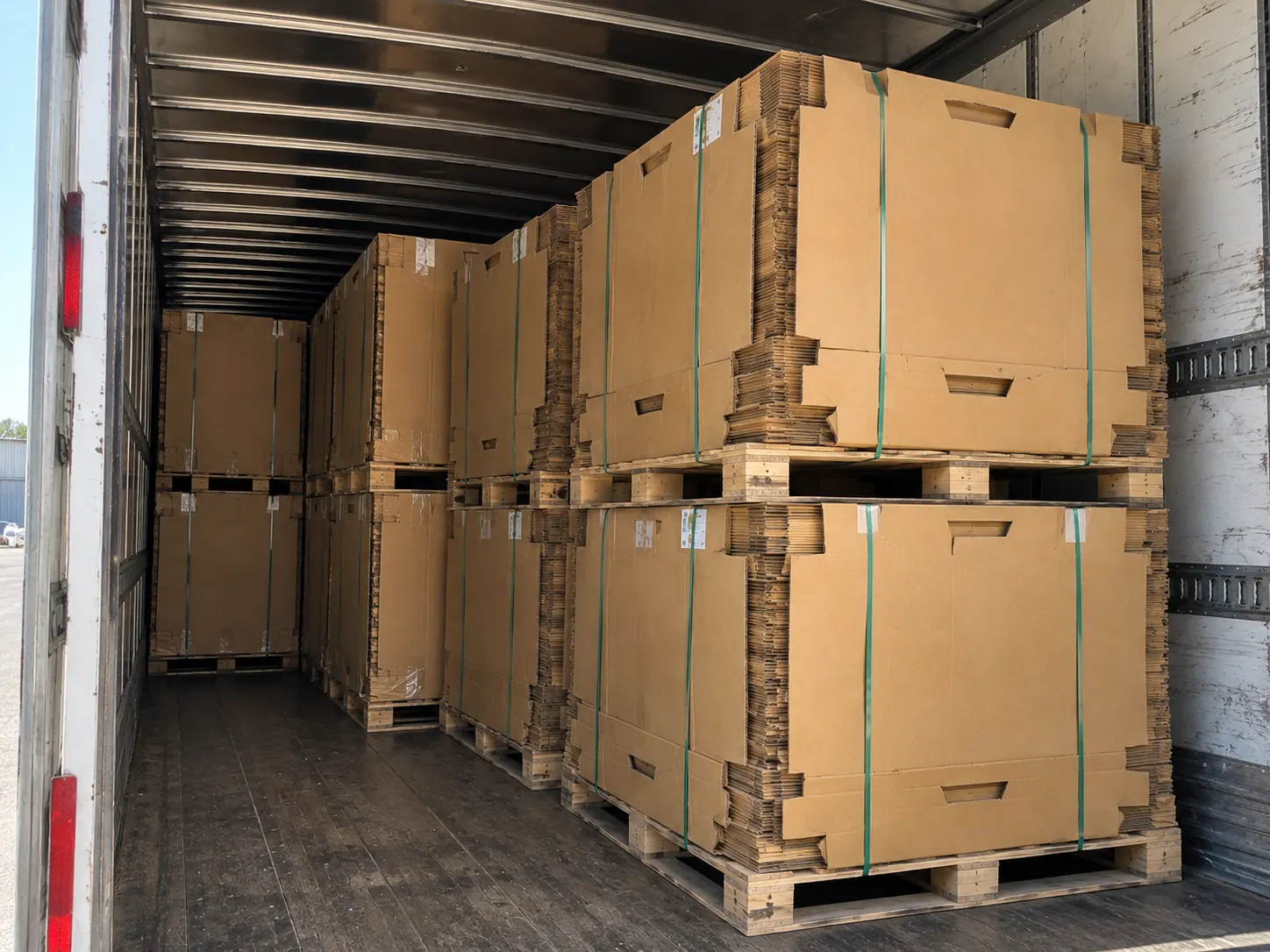
Flat cube is where every freight decision starts.
A 48 × 40 × 36 triple-wall gaylord occupies 40 cubic feet erected and about 4.7 knocked down. On a single 53-foot trailer that is 62 containers against 534.
Almost every freight decision in used packaging follows from that ratio, and almost no buyer has it to hand when they ask for a price.