We started because somebody was paying to throw away a perfectly good box.
Two people, a rented bay off Page Avenue, and a borrowed forklift. The business has grown considerably since 2008; the observation it was founded on has not changed at all.
Talk to us
Whether you are buying, selling or just curious how the grading works.
Straight to the grading floor at 9869 Meeks Blvd, St. Louis, MO 63132.
Or email sales@reboxesmarket.com. We have no phone line — dimensions and counts survive much better in writing.
Not sure of the size?
Fold a box in the browser, read off the cube and pallet fit, and send the spec straight through.
The observation
In 2008 one of our founders was working a dock on the north side of St. Louis. Twice a week a trailer collected flattened corrugated and took it away for a fee. Three miles down the road, a different plant bought new bulk containers every month. The boxes going out of one building were, in every meaningful respect, the boxes being bought by the other.
That is not an insight. It is just arithmetic nobody had bothered to do, because boxes are boring and nobody owns them. The entire company is built on continuing to do that arithmetic, in public, for eighteen years.
What we got wrong first
Our first two years were spent trying to sell used boxes on price alone. It does not work. A buyer who switches to used corrugated to save money switches straight back the first time a box fails in a rack. The thing that makes reuse stick is not cheapness — it is predictability.
So in 2010 we wrote a grade scale on the warehouse wall: A, B, C, scrap. We have refined the definitions since, but the categories have not changed, and every quote we have issued since names one of them. That single decision is why customers stay.
What we are, precisely
Not a broker. Not a recycler that also sells boxes. We are a yard: inbound material arrives, gets graded by a person within a day, gets repaired if it is worth repairing, and leaves as either a container, a converted product, or a bale. Everything happens in one building because the margins in reuse are too thin to survive being shipped between three.
And the missing phone number
We have never published one. Boxes are a business of dimensions, counts and grades, and those get mangled in conversation — someone says “about four foot” and three weeks later a trailer arrives with the wrong thing on it. Email and the form on this page give us the numbers in writing and give you a record. We answer within one business day, every day.
A rented bay and a borrowed forklift
Two founders start buying gaylords out of a single rented bay off Page Avenue, selling them to neighbouring manufacturers who were paying to throw identical boxes away.
Reconditioning opens
Flap splicing, panel patching and re-scoring. Boxes we had been baling for four years suddenly had a second career.
The Loop Index
We start marking containers and publishing trips-per-box data. Nine trips median. The number has been climbing ever since.
Meeks Boulevard
The move to 9869 Meeks Blvd: covered inbound, a proper grading floor, and a bench that is no longer a corner of the warehouse.
The yard, in numbers.
Eight failure modes, coded from our own retirements.
Ordered by share of retired containers. Note how few are repairable, and how many are prevented by something that costs almost nothing.
| Failure mode | Share | Repairable? | What prevents it |
|---|---|---|---|
| Forklift tine strike, lower long panel | 31% | Rarely | Floor approach guides, full-deck pallets, slower pick-face speed |
| Moisture through the flutes | 26% | No | Pallets not concrete, covered storage, let cold trailers equalise |
| Top-edge crush | 18% | Sometimes | Telescoping lids on anything stacked or racked |
| Strapping cut at the corner | 9% | Sometimes | Corner boards — the cheapest fix on this list |
| Corner rounding from over-stuffing | 7% | No | Do not fill above the top score line; buy the taller box |
| Cracked score lines | 5% | Yes, re-score | Separate lids instead of repeatedly folded flaps |
| Manufacturer's joint failure | 3% | Yes | Prefer stapled joints over glued for reuse |
| Delamination | 1% | No | Moisture control; there is no other cause worth chasing |
Seven repairs, and the limits of each.
Just as important as what a bench can fix is what it cannot. A repaired box that fails is worse than a baled one, and attempting the impossible repairs is how a yard destroys its own grade scale.
| Operation | Bench time | Life recovered | Material | Limit |
|---|---|---|---|---|
| Flap splice | 3 – 5 min | 2 – 4 trips | Recovered board offcut | Not viable past two missing flaps |
| Patch panel | 6 – 9 min | 3 – 5 trips | Recovered board offcut | Cannot patch a load-bearing vertical corner |
| Re-scoring | 2 – 3 min | 2 – 3 trips | None | Will not square a rounded corner |
| Edge reinforcement | 5 – 7 min | 3 – 4 trips | Recovered board strip | Needs sound board either side |
| Label & residue removal | 2 – 6 min | Appearance | Minimal | Heavy residue needs blank-out print |
| Blank-out printing | 1 – 2 min | Appearance | Ink | Single colour only |
| Corner post insertion | 8 – 12 min | 4 – 6 trips | Laminated board post | Only on triple wall |
Box Compression Test
Box Maker's Certificate
Edge Crush Test
European Federation of Corrugated Board Manufacturers
Full Overlap Slotted Container
Grocery Manufacturers Association (pallet)
Half Slotted Container
Institute of Scrap Recycling Industries
International Safe Transit Association
Less Than Truckload
Materials Recovery Facility
Thousand Square Feet
Old Corrugated Containers
Overlap Slotted Container
Regular Slotted Container
Sectional Center Facility
Technical Association of the Pulp and Paper Industry
Truckload
Work In Progress
We are a yard, not a broker
The distinction matters more than it sounds. A broker matches a seller to a buyer and takes a margin on the introduction; the material never stops. A yard takes physical possession, inspects every unit by hand, repairs what is worth repairing, converts what is not, and only then decides what each piece of material should become.
That costs vastly more in labour and floor space. It is also the only way to name a grade and mean it, and naming a grade is the thing customers actually buy from us.
Why everything happens in one building
Reuse margins are thin. Trucking material between a sorting site, a repair site and a warehouse adds handling cost at every node and eats the entire spread. So inbound, grading, the bench, the press, the baling line and outbound are all at Meeks Boulevard, in the physical order a box passes through them.
It limits how fast we can grow geographically and we have declined three expansion opportunities since 2019 because of it. We think the alternative is worse: a second site is how a yard quietly turns into a broker.
The economics in one paragraph
We buy material that somebody was paying to dispose of. We add grading, repair and sorting labour. We sell a graded, counted, matched product with freight optimised around cube rather than weight. The margin is the difference between commodity fibre value and container value, and it is large enough to support a serious inspection operation — which is precisely why the inspection operation exists.
What we have got wrong
- Our first two years were spent selling on price alone. It does not work: buyers who switch to used board to save money switch back the first time a box fails in a rack.
- We had a rule about always saying yes to the customer. It led to shipping grade C board to someone who needed grade A because they insisted on a price. We deleted the rule.
- We underestimated a customer's waste stream in 2023 and our contamination rate rose for two quarters. We published it, lost a prospect, and fixed the sorting step.
- We graded on outbound for years before realising that grading on inbound is the only version that protects the customer.
Seven lines, and the two nobody counts.
Purchase price is the least interesting number in container economics. Damage caused by container failure is almost universally coded as handling damage, which hides the largest controllable line on the list.
| Cost line | Share of total | Commonly counted? |
|---|---|---|
| Purchase or rental | 34% | Always |
| Inbound freight | 9% | Usually |
| Storage and yard space | 11% | Rarely |
| Sorting and inspection labour | 14% | Rarely |
| Repair | 8% | Sometimes |
| Disposal of unusable units | 6% | Rarely |
| Product damage from container failure | 18% | Almost never |
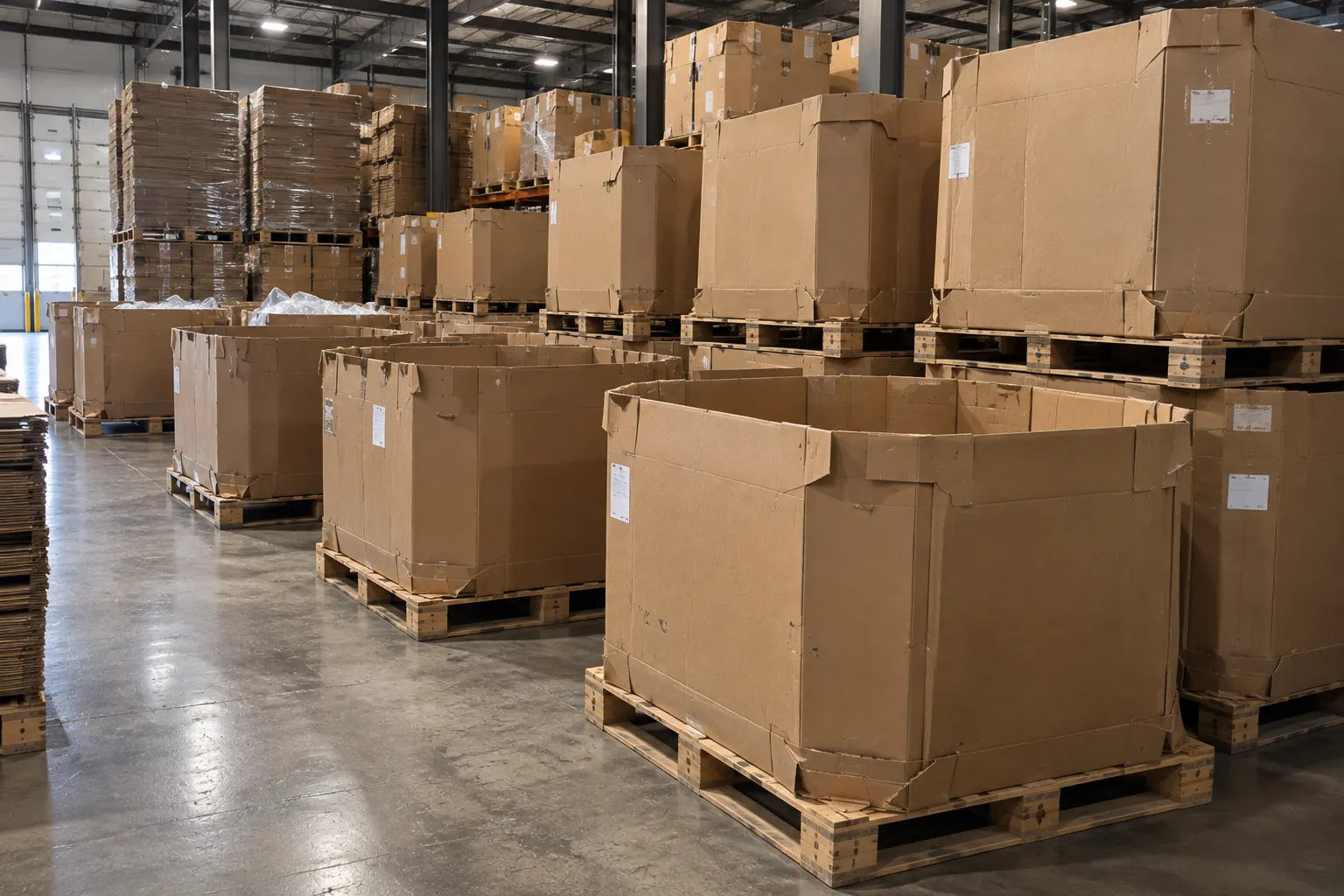
One roof, arranged in the order a box gets better.
Inbound, grading floor, repair bench, honeycomb press, baling line and outbound banding — all at 9869 Meeks Blvd, in sequence, with nothing moving backwards.
It limits how fast we can grow geographically, and we have declined three expansion opportunities since 2019 because of it. Reuse margins do not survive being trucked between three sites.