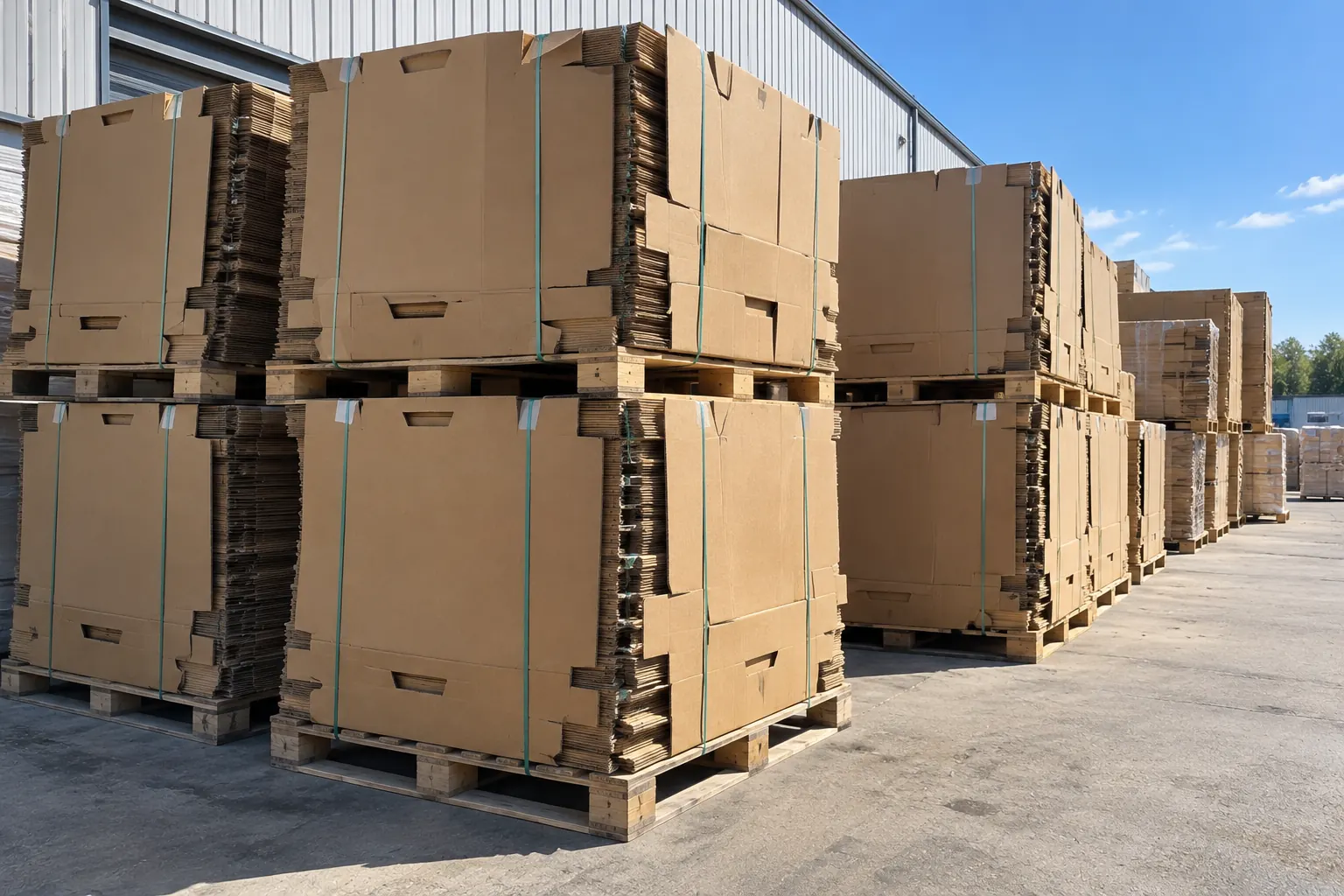
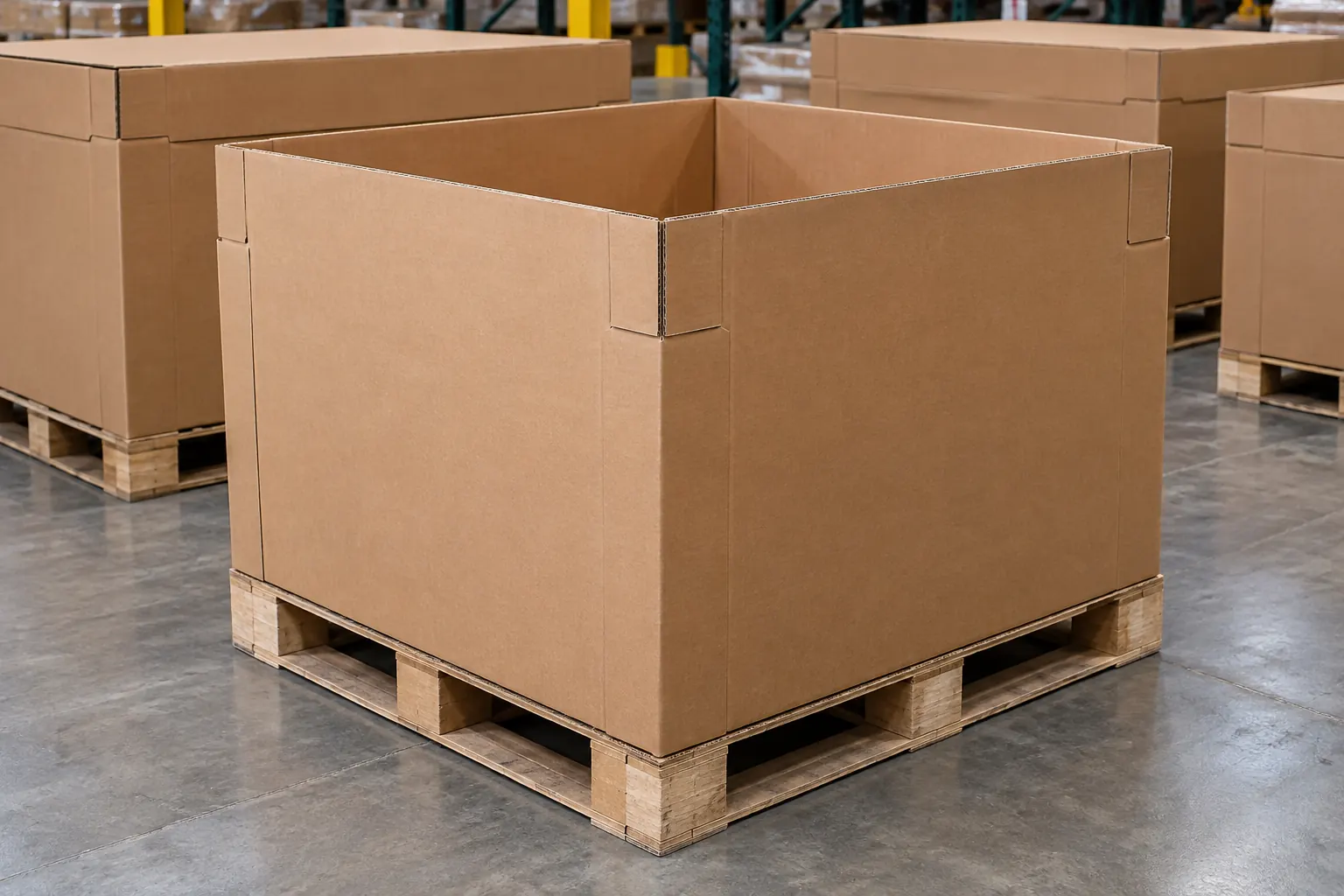
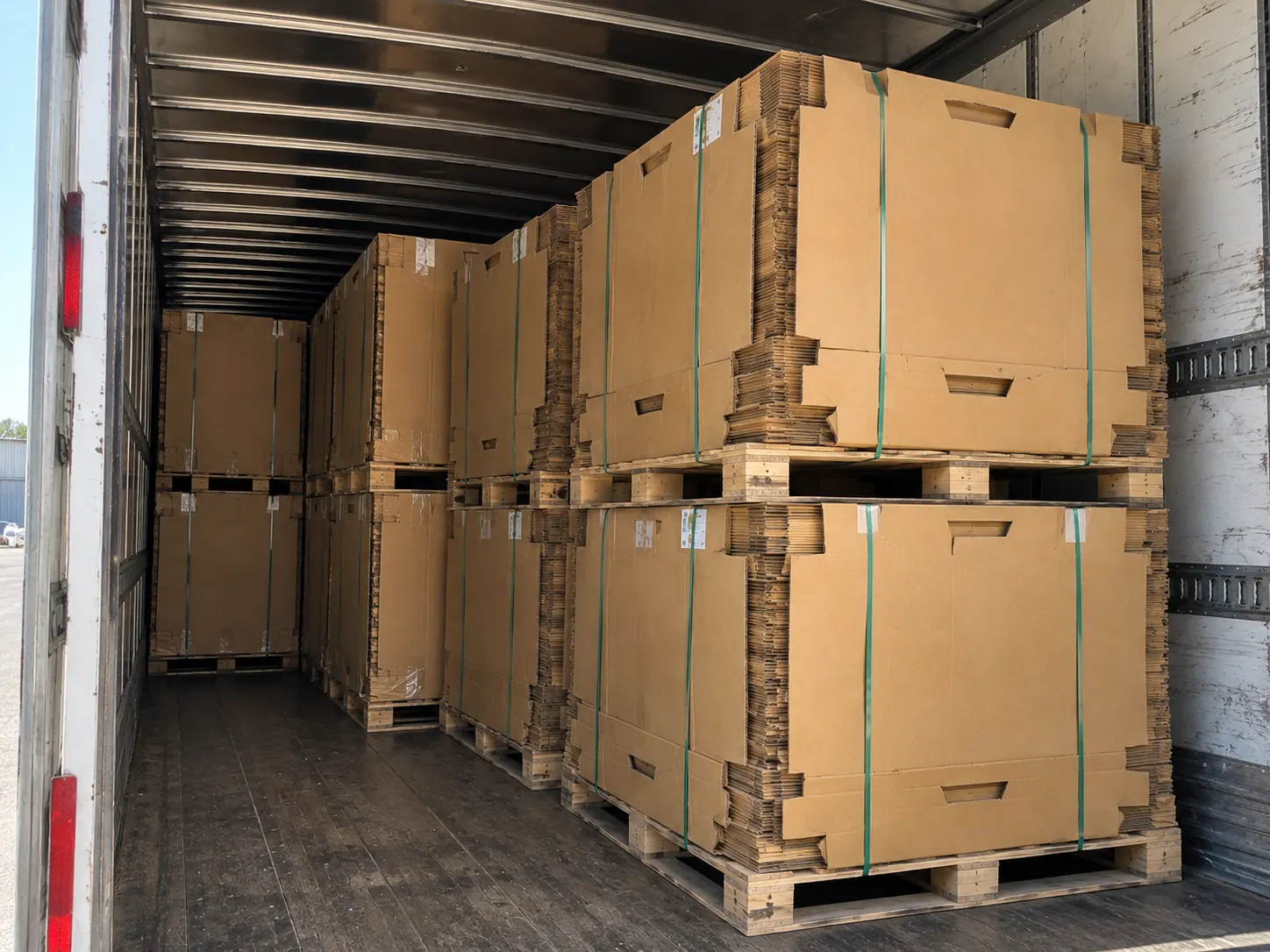
112,000 square feet, arranged in the order a box gets better.
Most box yards are arranged around storage. Ours is arranged around a sequence: nothing moves backwards, and nothing waits outside in the weather.
Arrange a visit
Customers are welcome on the grading floor. Tell us roughly when and we will set it up.
Straight to the grading floor at 9869 Meeks Blvd, St. Louis, MO 63132.
Or email sales@reboxesmarket.com. We have no phone line — dimensions and counts survive much better in writing.
Not sure of the size?
Fold a box in the browser, read off the cube and pallet fit, and send the spec straight through.
Follow a box from the trailer to the trailer.
A container arriving on a Tuesday morning is graded by Tuesday afternoon, repaired by Wednesday and banded for outbound by Thursday. That cadence is the whole operation.
Covered inbound
Everything comes off the trailer under roof. Moisture is the single biggest destroyer of reusable board, and a wet receiving bay quietly ruins a third of your inventory.
Grading floor
Six stations, each with a light bar at a fixed angle so creasing and liner variation show up consistently. Graders rotate stations hourly — accuracy drops noticeably after sixty minutes.
Repair bench
Flap splicing, patch panels, re-scoring, edge reinforcement. Eight benches, all fed from recovered board cut in-house. The most profitable square footage in the building.
Re-face station
Label and adhesive removal, blank-out printing, single-colour marking. Boxes that look like rubbish get treated like rubbish, so appearance is a structural concern.
Honeycomb press
Laminating recovered board into structural panel from half an inch to two inches. Where boxes go when they can no longer be boxes.
Baling line
Mill grade #11 and #12 OCC, moisture metered, contamination logged per bale. The last resort, and we treat it as one.
Outbound banding
Knocked down, nested, banded and cube-checked. A trailer that leaves half-empty is a carbon failure as much as a commercial one.
Specifications, since people ask.
| Element | Detail | Why it matters |
|---|---|---|
| Footprint | 112,000 sq ft under roof | All grading, repair and storage indoors |
| Dock doors | 14 (4 covered drive-in) | Live loading without exposing board to weather |
| Clear height | 32 ft | Six-high knocked-down storage without crushing |
| Inbound capacity | 11 trailers per day | Same-day grading at full volume |
| Repair benches | 8 | Roughly 900 containers repaired weekly |
| Baler | Horizontal, auto-tie | Mill grade #11 / #12 OCC |
| Honeycomb press | 1/2" – 2" panel | Converts structurally spent board |
| Yard trailers | 9 (incl. 3 drop) | Milk runs and reverse loads on our own equipment |
You are welcome on the floor. Bring safety shoes.
We would much rather you looked at the grading stations yourself than took our word for the scale. Visits run Monday to Thursday, 9:00 AM to 3:00 PM CT.
9869 Meeks Blvd, St. Louis, MO 63132 · email hello@reboxesmarket.com with a date and we will confirm.
What we will put on your site, and when it is worth it.
Thresholds move with labour cost and OCC price. Below two tons a month a baler will never pay back, and we will say so rather than place one.
| Monthly OCC volume | Recommended | Capital | Why | Serviced by |
|---|---|---|---|---|
| Under 2 tons / month | Gaylord collection points | None | A baler will never pay back at this volume | We collect on a milk run |
| 2 – 8 tons / month | Vertical baler | Low | Small footprint, manual tie, low capital | Us, quarterly |
| 8 – 25 tons / month | Horizontal baler, manual tie | Medium | Throughput without a dedicated operator | Us, monthly |
| 25 – 60 tons / month | Horizontal auto-tie | High | Continuous feed, consistent bale weight | Us, monthly |
| 60+ tons / month | Auto-tie plus compactor swap | High | Mixed stream handling alongside OCC | Us plus your hauler |
| Seasonal spike only | Drop trailer | None | No capital at all — a box on wheels | Us, on schedule |
The nine points, in the order a grader checks them.
Ordered by how well each point predicts failure under load, not by how obvious it is. The first one is the least visible and the most important.
| # | What is checked | What disqualifies | Downgrades to |
|---|---|---|---|
| 1 | Bottom third of the long panel | Soft, fuzzed or delaminated board from tine strikes | Recovery |
| 2 | Vertical corner squareness | Corners bowed outward from over-stuffing | C, or recovery if severe |
| 3 | Liner colour banding | Patchy darkening indicating moisture cycling | Recovery |
| 4 | Flap edge condition | Fuzzed or feathered edges; missing flap corners | C, or bench repair |
| 5 | Score line integrity | Cracked rather than creased folds | C, or bench re-score |
| 6 | Manufacturer's joint | Separated glue line or pulled staples | Bench repair |
| 7 | Interior cleanliness | Residue, dust, previous product traces | C |
| 8 | Print and label residue | Heavy multi-colour print or continuous tape bands | B at best; re-face station |
| 9 | Top edge crush | Crushing on stacked or racked units | Bench reinforcement, else C |
Seven repairs, and the limits of each.
Just as important as what a bench can fix is what it cannot. A repaired box that fails is worse than a baled one, and attempting the impossible repairs is how a yard destroys its own grade scale.
| Operation | Bench time | Life recovered | Material | Limit |
|---|---|---|---|---|
| Flap splice | 3 – 5 min | 2 – 4 trips | Recovered board offcut | Not viable past two missing flaps |
| Patch panel | 6 – 9 min | 3 – 5 trips | Recovered board offcut | Cannot patch a load-bearing vertical corner |
| Re-scoring | 2 – 3 min | 2 – 3 trips | None | Will not square a rounded corner |
| Edge reinforcement | 5 – 7 min | 3 – 4 trips | Recovered board strip | Needs sound board either side |
| Label & residue removal | 2 – 6 min | Appearance | Minimal | Heavy residue needs blank-out print |
| Blank-out printing | 1 – 2 min | Appearance | Ink | Single colour only |
| Corner post insertion | 8 – 12 min | 4 – 6 trips | Laminated board post | Only on triple wall |
What actually fits in the truck.
Every cube figure we quote is calculated against these, at a realistic 72% packing efficiency rather than a theoretical 100%.
| Unit | Inside dimensions | Volume | Pallet positions | Payload | Note |
|---|---|---|---|---|---|
| 53' dry van | 630" × 100" × 110" | 3,489 ft³ | 26 | 45,000 lb | Our standard outbound unit |
| 48' dry van | 576" × 99" × 108" | 3,100 ft³ | 24 | 44,000 lb | Older fleet, still common on LTL |
| 28' pup | 330" × 100" × 108" | 1,750 ft³ | 12 | 22,000 lb | LTL linehaul segment |
| 26' straight truck | 306" × 96" × 96" | 1,700 ft³ | 12 | 10,000 lb | Liftgate deliveries to sites without docks |
| 40' container | 474" × 92" × 94" | 2,390 ft³ | 20 | 59,000 lb | Export; corrugated avoids ISPM 15 |
| 40' high cube | 474" × 92" × 106" | 2,694 ft³ | 20 | 58,000 lb | Preferred for low-density freight |
What comes off each machine, and how many fit a trailer.
Mills price on consistency as much as on grade. Auto-tie machines produce the most uniform bale weight, which is why they attract a better number per ton than their throughput alone would justify.
| Baler | Typical bale size | Bale weight | Bales per trailer | Note |
|---|---|---|---|---|
| Vertical, small | 60 × 30 × 48" | 500 – 800 lb | 40 – 48 | Manual tie, lowest capital |
| Vertical, large | 60 × 30 × 60" | 800 – 1,100 lb | 36 – 44 | Still manual tie |
| Horizontal, manual tie | 60 × 30 × 48" | 900 – 1,300 lb | 34 – 40 | Continuous feed |
| Horizontal, auto-tie | 72 × 30 × 48" | 1,200 – 1,600 lb | 28 – 34 | Consistent weight; mills prefer it |
| Two-ram | 60 × 43 × 48" | 1,400 – 1,900 lb | 24 – 28 | Mixed-material sites |
| Year | Market level | What drove it |
|---|---|---|
| 2019 | Low | Post-import-restriction glut; some regions near zero |
| 2020 | Rising | E-commerce surge tightened supply of recovered fibre |
| 2021 | High | Containerboard demand peak; multi-year highs |
| 2022 | Falling | Demand correction as retail inventories unwound |
| 2023 | Low to moderate | Soft demand; mill downtime |
| 2024 | Moderate | Gradual recovery, regional spreads widened |
| 2025 | Moderate | Stable; export pull supported coastal markets |
| 2026 | Moderate to firm | Inland markets lagging coastal by a visible margin |
Direction only — published indices vary by region and by mill, and inland markets have been lagging coastal ones by a visible margin. We will tell you where your region sits rather than quoting a national average at you.
What the rack does to the box.
Container specification and racking choice are the same decision made twice. Drive-in and push-back racking are where we see the most container damage, because the container is handled blind.
| Rack type | Beam span | Load capacity | Effect on containers |
|---|---|---|---|
| Selective pallet rack | 96 – 144" | 2,500 – 6,000 lb/level | Most common; one pallet deep |
| Double deep | 96 – 108" | 2,500 – 5,000 lb/level | Needs a reach truck; container squareness critical |
| Drive-in | N/A, rails | 2,000 – 4,000 lb/pallet | Container damage risk is highest here |
| Push-back | 96 – 120" | 2,200 – 4,500 lb/pallet | Dynamic load; overhang is unforgiving |
| Pallet flow | 96 – 120" | 2,000 – 3,000 lb/pallet | Bottom-board condition decides whether it rolls |
| Floor stacking | N/A | Board-limited | Where box compression strength actually binds |
| Item | Limit | Note |
|---|---|---|
| Single-person lift, ideal zone | Up to 35 lb | Between knuckle and shoulder height, close to the body |
| Single-person lift, absolute | 50 lb | Common carrier and insurer threshold for cartons |
| Two-person lift | Up to 100 lb | Requires clear path and matched heights |
| Carton max gross, 32 ECT | 65 lb | Certificate limit, not a handling recommendation |
| Carton max gross, 48 ECT | 120 lb | Mechanical handling expected |
| Gaylord, loaded | 1,800 – 2,400 lb | Forklift or pallet truck only |
| Pallet jack, manual | 5,500 lb | Flat floors only |
| Counterbalance forklift, typical | 5,000 lb at 24" load centre | Derates sharply as load centre moves out |
Five levels, and what each is good for.
No level of cleaning makes a used corrugated container suitable for direct food contact. What it does is make a container acceptable for its actual application, which is a different and answerable question.
| Level | Method | Suited to |
|---|---|---|
| Visual inspection only | Grading station check for residue and odour | General industrial, scrap, internal moves |
| Vacuum and blow-down | Compressed air and industrial vacuum | Resin, granulate, dusty materials |
| Label and residue removal | Mechanical removal at the re-face station | Anything customer-facing |
| Liner barrier | New FDA-compliant liner each cycle | Food ingredients, pet food, produce |
| Secure destruction | Shredding and baling with certification | Branded or regulated containers |
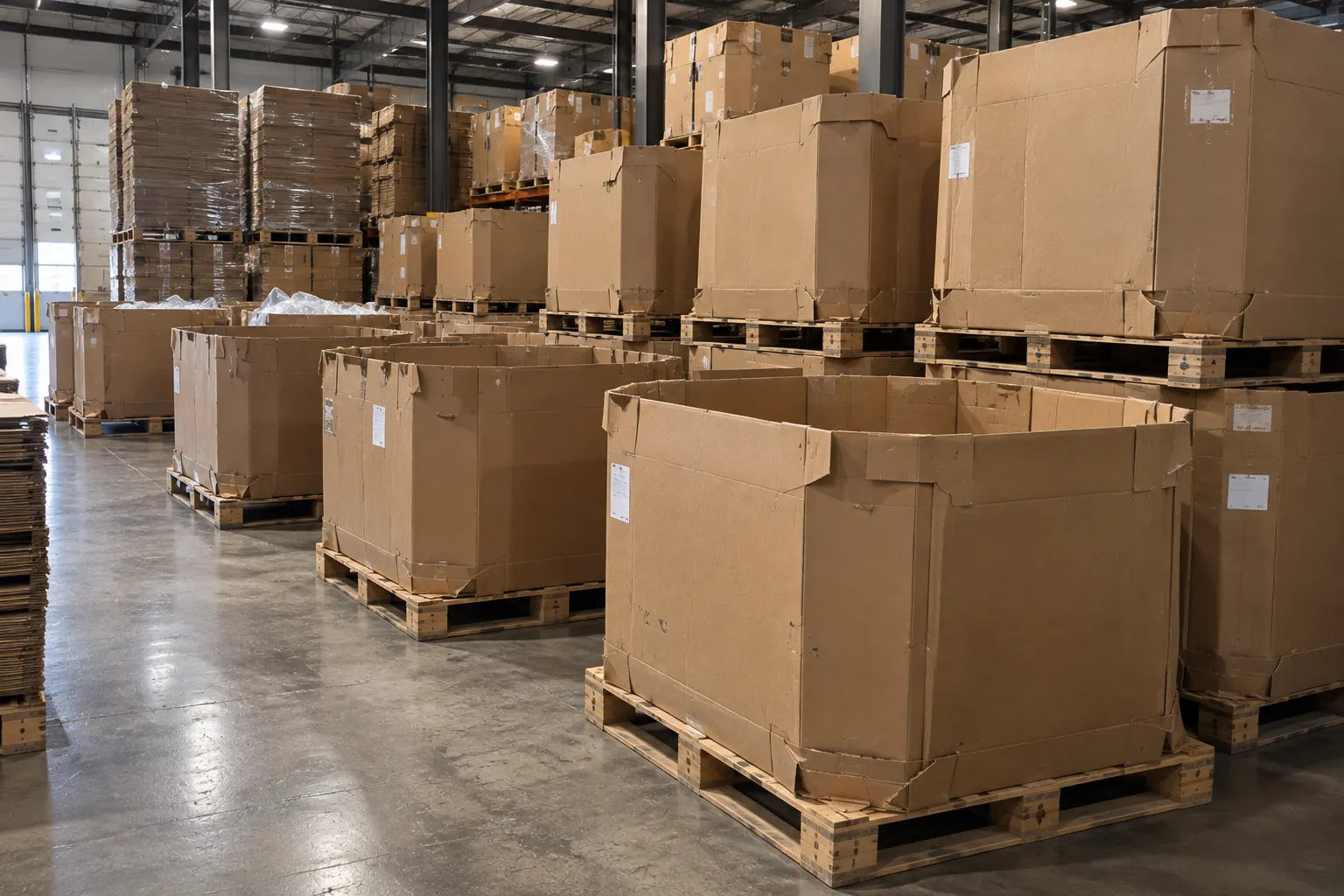
Covered inbound, a proper grading floor, and a bench that is no longer a corner of the warehouse.
Fourteen dock doors, 32 feet of clear height, eight repair benches and nine trailers. Customers are welcome on the floor Monday to Thursday — bring safety shoes.
Three views of a normal Tuesday.
Inbound awaiting grading, a graded container ready for release, and banded knocked-down board waiting for a trailer.