Fold a box in your browser.
This is the calculator our graders use on the floor. Drag three sliders, flip the container into its die-line, and watch the cube, the pallet fit, the trailer count and the avoided carbon update as you go. Then attach the exact spec to the form and send it to us.
Send a spec
Use the 'Attach this spec' button below and this form fills itself in.
Set the dimensions
Length, width and height in inches — inside dimensions, as always.
Flip to the die-line
See the same box unfolded as a FEFCO 0201 blank, with the fold lines marked.
Attach the spec
One click fills this form with the exact numbers. Add your details and send.
These are estimates for comparison, not quotations. Real board weight varies with basis weight and liner spec, and real pallet fit depends on the pallets you actually own rather than the ones in the standard.
Inside dimensions
That is 8.6× more boxes on the same truck. It is the single biggest lever in the economics — and the carbon — of reuse, and it is why we band everything flat before it leaves Meeks Boulevard.
Working: 1.30 kg CO₂e per kg of virgin corrugated, cradle-to-gate, against 0.215 kg per kg for a reuse cycle including collection freight, grading labour and repair board. We exclude end-of-life recycling credit and stored fibre carbon on purpose — both would flatter the number.
Drop this exact spec into the enquiry form at the top of the page.
Six formulas, no magic.
We would rather you could check the arithmetic than trust a black box. These are the exact expressions behind the readouts above.
| Readout | Formula | Assumption |
|---|---|---|
| Cube, erected | (L × W × H) ÷ 1,728 | Inside dimensions |
| Die-line blank area | (2L + 2W + 2) × (H + W) | FEFCO 0201 RSC, 2″ glue tab |
| Board per box | (blank ÷ 144) × lb per ft² | 0.20 / 0.33 / 0.55 lb per ft² for single / double / triple |
| Knocked-down cube | (blank × caliper) ÷ 1,728 | 0.16″ / 0.30″ / 0.60″ caliper |
| Per 48 × 40 pallet | best of two orientations × floor(60 ÷ H) | 60″ usable stack height |
| Per 53′ trailer | (3,489 ft³ × 0.72) ÷ cube | 72% realistic packing efficiency |
| CO₂e avoided | kg board × (1.30 − 0.215) | Virgin board versus a reuse cycle |
All figures are estimates for comparison, not quotations. Real board weight varies with basis weight and liner specification; real pallet fit depends on the pallets you actually own. We use these numbers to have a sensible conversation, then measure properly before anything ships.
Numbers that surprise almost everybody.
Knocked down versus erected
A flat 48 × 40 × 36 gaylord occupies about a ninth of the trailer space of an erected one. On smaller boxes the ratio is even steeper.
A standard gaylord's cube
Which sounds abstract until you notice it is roughly a domestic chest freezer, sitting on a pallet, made of paper.
Inside to outside, triple wall
Enough to turn a flush pallet fit into an overhang, and an overhang into three lost trips per container.
About the studio.
Is this a quotation tool?
No. It is a sizing and comparison tool. It will get you to the right conversation far faster than email, but a real quote needs grade, lane and availability, which only a person can sort out.
Why does the die-line look like that?
It is a FEFCO 0201 regular slotted container blank: four body panels, eight flaps each half the box width, and a glue tab. Dashed lines are folds and scores; solid lines are cuts.
Where do the carbon coefficients come from?
Published life-cycle figures for corrugated, cross-checked against our own measured reuse-cycle costs. Every coefficient is listed on the sustainability page so you can substitute your own.
Does it work on a phone?
Yes — the sliders are touch-friendly and the box renders in CSS, so there is nothing heavy to download. It is genuinely nicer on a laptop, but it works.
Can I use it without JavaScript?
The interactive part needs JavaScript, so if you have it switched off you will see the static version. Everything else on this site — every link, every form, the menu and the quote overlay — works without it.
Ten conversions we use every day.
None of these are difficult. All of them are regularly got wrong, usually by a factor of 1,728.
| From | To | Factor | Worked example |
|---|---|---|---|
| Cubic inches | Cubic feet | ÷ 1,728 | 48 × 40 × 36 = 69,120 in³ = 40.0 ft³ |
| Square inches | Square feet | ÷ 144 | 13,528 in² = 93.9 ft² |
| Pounds per ft² | Board weight | × area in ft² | 93.9 ft² × 0.55 = 51.7 lb |
| Pounds | Kilograms | × 0.45359 | 51.7 lb = 23.5 kg |
| Inches | Millimetres | × 25.4 | 48" = 1,219 mm |
| Cubic feet | Cubic metres | × 0.02832 | 40.0 ft³ = 1.13 m³ |
| Short tons | Metric tonnes | × 0.90718 | 11,800 tons = 10,705 tonnes |
| Loose OCC volume | Weight | × 80 lb/yd³ | 40 yd³ ≈ 3,200 lb |
| Baled OCC volume | Weight | × 700 lb/yd³ | 2 yd³ bale ≈ 1,400 lb |
| Trailer volume (53') | Usable | × 0.72 | 3,489 ft³ → 2,512 ft³ |
What actually fits in the truck.
Every cube figure we quote is calculated against these, at a realistic 72% packing efficiency rather than a theoretical 100%.
| Unit | Inside dimensions | Volume | Pallet positions | Payload | Note |
|---|---|---|---|---|---|
| 53' dry van | 630" × 100" × 110" | 3,489 ft³ | 26 | 45,000 lb | Our standard outbound unit |
| 48' dry van | 576" × 99" × 108" | 3,100 ft³ | 24 | 44,000 lb | Older fleet, still common on LTL |
| 28' pup | 330" × 100" × 108" | 1,750 ft³ | 12 | 22,000 lb | LTL linehaul segment |
| 26' straight truck | 306" × 96" × 96" | 1,700 ft³ | 12 | 10,000 lb | Liftgate deliveries to sites without docks |
| 40' container | 474" × 92" × 94" | 2,390 ft³ | 20 | 59,000 lb | Export; corrugated avoids ISPM 15 |
| 40' high cube | 474" × 92" × 106" | 2,694 ft³ | 20 | 58,000 lb | Preferred for low-density freight |
What a square foot of each build actually weighs.
The number you need to turn a die-line area into a shipping weight, a carbon figure or a freight class. Multiply blank area in square feet by the figure below.
| Construction | lb per ft² | lb per MSF | Caliper | Note |
|---|---|---|---|---|
| Single wall, 32 ECT (C flute) | 0.20 | 200 | 0.16" | Lightest practical shipper |
| Single wall, 44 ECT (C flute) | 0.24 | 240 | 0.17" | Heavier liner, same flute |
| Double wall, 48 ECT (BC) | 0.33 | 330 | 0.30" | The reuse workhorse |
| Double wall, 61 ECT (BC) | 0.40 | 400 | 0.32" | Heavy distribution |
| Triple wall, 71 ECT | 0.48 | 480 | 0.52" | Crate replacement |
| Triple wall, 1,100 lb test | 0.55 | 550 | 0.60" | Gaylord standard |
| Honeycomb panel, 1" | 0.35 – 0.60 | — | 1.00" | Dunnage and display substrate |
It replaces an email thread
Before this existed, a typical sizing conversation ran four or five emails: you send dimensions, we calculate the cube, you ask about pallet fit, we work out the trailer count, and somewhere in there somebody confuses inside and outside measurements. The studio collapses all of that into a slider you can drag while reading.
The three numbers that surprise people
- Knocked-down versus erected cube. For a standard gaylord the ratio is about 8.6 to one, and it is the single biggest lever on delivered cost in this entire trade.
- Die-line blank area. A 48 × 40 × 36 box is cut from roughly 13,500 square inches of board — about 94 square feet, which is why board weight matters on weight-constrained lanes.
- Inside to outside on triple wall. 1.25 inches on every axis, which is enough to turn a flush pallet fit into an overhang and an overhang into three lost trips.
What it deliberately does not do
It does not quote. Availability, grade, lane and condition are decisions that need a person who has walked the floor, and a calculator that pretended otherwise would be misleading. What it does is get you to the right conversation far faster, with the arithmetic already agreed.
Checking our working
Every formula behind the readouts is published below, along with the coefficients. Board weights are nominal for each construction and real figures vary with basis weight and liner specification; pallet fit assumes the standard deck rather than the pallets you actually own. Treat the outputs as a sound basis for a conversation and measure properly before anything ships.
Why empty packaging rates so badly.
LTL pricing keys off density. Knocked-down corrugated weighs almost nothing and occupies a full pallet position, so it lands near the expensive end of a scale designed around weight.
| Class | Density | Typical commodity | Where packaging sits |
|---|---|---|---|
| 50 | 50+ lb/ft³ | Bricks, steel bar | Rarely packaging |
| 55 | 35 – 50 | Hardwood flooring | Dense palletised goods |
| 60 | 30 – 35 | Car accessories | Heavy cartoned goods |
| 65 | 22.5 – 30 | Bottled beverages | Full case packs |
| 70 | 15 – 22.5 | Food in cartons | Typical dense distribution |
| 85 | 12 – 15 | Crated machinery | Palletised assemblies |
| 92.5 | 10.5 – 12 | Computers, monitors | Cushioned electronics |
| 100 | 9 – 10.5 | Boat covers, canvas | Light bulky goods |
| 125 | 7 – 8 | Small appliances | Void-filled cartons |
| 150 | 6 – 7 | Auto sheet metal | Erected boxes start here |
| 175 | 5 – 6 | Clothing, couches | Knocked-down heavy board |
| 200 | 4 – 5 | Aircraft parts | Knocked-down double wall |
| 250 | 3 – 4 | Mattresses, plasma TVs | Knocked-down single wall |
| 300 | 2 – 3 | Wood cabinets, tables | Erected gaylords |
| 400 | 1 – 2 | Deer antlers | Erected light bulk |
| 500 | < 1 | Gold dust, ping-pong balls | Loose void fill |
Note the two rows that matter here: knocked-down board is class 150 – 250, erected containers are class 300 – 400. That gap is the entire argument for banding everything flat.
The liners and mediums underneath every box.
Board specification starts one level below the box: which liner, which medium, at what basis weight. Basis weight is stated in pounds per thousand square feet.
| Grade | Basis weight | Fibre | Typical use | Note |
|---|---|---|---|---|
| Kraft liner 26# | 26 lb/MSF | Virgin kraft | Light single wall | Lowest practical outer liner |
| Kraft liner 33# | 33 lb/MSF | Virgin kraft | Standard 32 ECT outer | The commonest liner in North America |
| Kraft liner 42# | 42 lb/MSF | Virgin kraft | 44 ECT and double wall | Noticeably stiffer, better print |
| Kraft liner 69# | 69 lb/MSF | Virgin kraft | Triple wall outer | Gaylord-grade facing |
| Test liner 2 | 27 – 50 lb/MSF | ≥ 80% recycled | General shipper | Most recycled-content board |
| Test liner 3 | 27 – 50 lb/MSF | 100% recycled | Internal and bulk | Lower burst for the same weight |
| Mottled white | 35 – 42 lb/MSF | Mixed | Retail-facing print | White outer, kraft back |
| Semi-chem medium 26# | 26 lb/MSF | Semi-chemical | Standard flute medium | Highest stiffness per weight |
| Recycled medium 23# | 23 lb/MSF | 100% recycled | Economy flute medium | Common in test-liner board |
| Type | Where it is used | Water resistance | Recycling | Note |
|---|---|---|---|---|
| Starch (corrugating) | Liner to medium | Low resistance | Ideal | The standard bond in all corrugated board |
| Hot melt EVA | Manufacturer's joint, cases | Moderate | Tolerated | Fast set; brittle when cold |
| Cold-set PVA | Case sealing | Low | Ideal | Slow set, strong fibre tear |
| Water-resistant starch | Produce board | High | Good | Alternative to wax for damp environments |
| Pressure-sensitive | Tape, labels | Varies | Tolerated in small amounts | Residue downgrades grade A board |
| Stitching (staples) | Manufacturer's joint | Unaffected | Removed in the junk trap | Outlasts glue through reuse cycles |
Seven lines, and the two nobody counts.
Purchase price is the least interesting number in container economics. Damage caused by container failure is almost universally coded as handling damage, which hides the largest controllable line on the list.
| Cost line | Share of total | Commonly counted? |
|---|---|---|
| Purchase or rental | 34% | Always |
| Inbound freight | 9% | Usually |
| Storage and yard space | 11% | Rarely |
| Sorting and inspection labour | 14% | Rarely |
| Repair | 8% | Sometimes |
| Disposal of unusable units | 6% | Rarely |
| Product damage from container failure | 18% | Almost never |
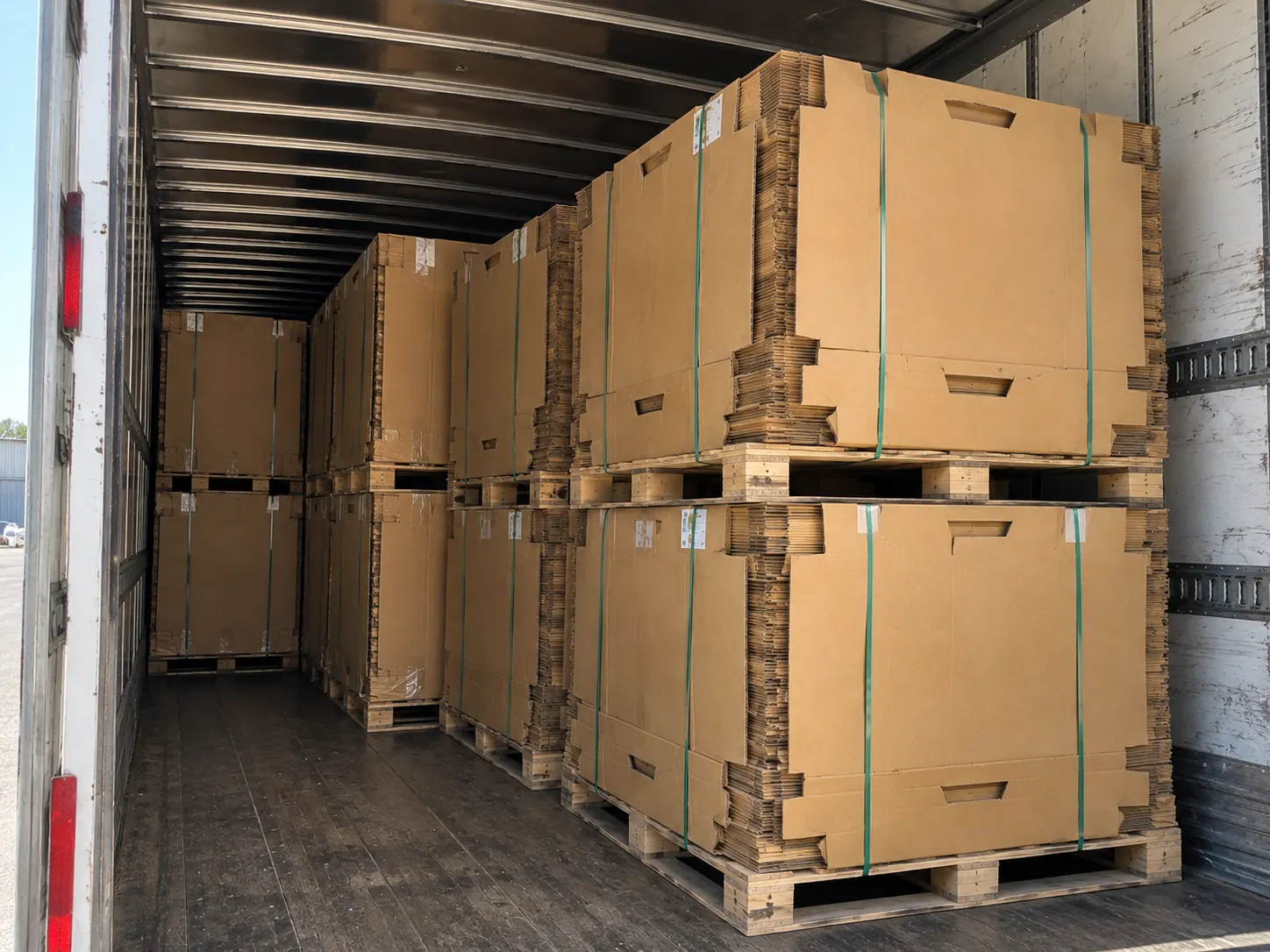
This is 'knocked down' in the physical world.
Banded flat on pallets, ready for a trailer. The studio's cube figures describe exactly this — blank area, caliper, and the volume a stack of them actually occupies.
Drag the sliders above and the knocked-down figure updates alongside the erected one. The gap between the two is the whole argument.