Freight & logistics
Hauling empty boxes badly is how reuse gets expensive. We knock down, band, nest and stack to fill a trailer properly, and we run our own equipment out of St. Louis.
Start: freight & logistics
Pre-filled for this service. Add the detail and it reaches the floor.
An empty box is 95% air.
Which means freight, not board, decides whether reuse is cheaper than buying new on your lane. We quote the cube before we quote the price.
Nine trailers including three drop units, running recurring Midwest routes. Owning the equipment is why reverse loads are possible at all.
Four steps, in this order, every time.
Cube first
We calculate knocked-down cube before we quote, so you pay for a full trailer, not a half-empty one.
Right mode
LTL, partial, full truckload or drop trailer. We will tell you which is cheaper.
Milk runs
Recurring routes through the Midwest that collect and deliver on the same pass.
Reverse loads
Your outbound empties ride back on our returning trailer. Half the carbon, half the invoice.
Boxes are mostly air — we price accordingly.
Everything here happens out of one building at 9869 Meeks Blvd, St. Louis. That is not a detail — it is the only reason the numbers work.
Which one is cheaper is not always obvious.
We will tell you when a mode you did not ask for is better, including when it means less revenue for us.
| Mode | Sweet spot | Watch out for | Typical use here |
|---|---|---|---|
| LTL | 1 – 6 pallets | Freight class on low-density cube; accessorials | Small standing orders, accessory top-ups |
| Partial truckload | 7 – 14 pallets | Co-load timing and transit variability | Mid-size orders on established lanes |
| Full truckload | 20 – 26 pallets | Paying for a trailer you only half fill | Gaylords, bulk runs, nationwide lanes |
| Drop trailer | Continuous flow | Yard space and detention terms | Collection from docks, seasonal spikes |
| Milk run | Recurring multi-stop | Schedule discipline at every node | Midwest zone 2 routes, weekly |
| Reverse load | Matched out-and-back | Needs volume both directions | Your empties ride our returning trailer |
Same-day & next-day
Within 150 miles of St. Louis
Own equipment, drop trailers available, same-day pickup on standing accounts.
Scheduled milk runs
150 – 450 miles
Recurring weekly routes that collect and deliver on the same pass.
Truckload lanes
450 – 900 miles
Full and partial truckload, knocked down and banded for cube efficiency.
Nationwide
Continental US
Full truckload only. We will tell you plainly when freight makes reuse uneconomic for your lane.
Half the carbon, half the invoice.
If we are delivering to you, our trailer goes home empty unless you have something to put in it. Your outbound empties on our return leg is the cheapest freight either of us will ever buy, and the lowest-carbon mile in the whole loop.
What actually fits in the truck.
Every cube figure we quote is calculated against these, at a realistic 72% packing efficiency rather than a theoretical 100%.
| Unit | Inside dimensions | Volume | Pallet positions | Payload | Note |
|---|---|---|---|---|---|
| 53' dry van | 630" × 100" × 110" | 3,489 ft³ | 26 | 45,000 lb | Our standard outbound unit |
| 48' dry van | 576" × 99" × 108" | 3,100 ft³ | 24 | 44,000 lb | Older fleet, still common on LTL |
| 28' pup | 330" × 100" × 108" | 1,750 ft³ | 12 | 22,000 lb | LTL linehaul segment |
| 26' straight truck | 306" × 96" × 96" | 1,700 ft³ | 12 | 10,000 lb | Liftgate deliveries to sites without docks |
| 40' container | 474" × 92" × 94" | 2,390 ft³ | 20 | 59,000 lb | Export; corrugated avoids ISPM 15 |
| 40' high cube | 474" × 92" × 106" | 2,694 ft³ | 20 | 58,000 lb | Preferred for low-density freight |
Ten conversions we use every day.
None of these are difficult. All of them are regularly got wrong, usually by a factor of 1,728.
| From | To | Factor | Worked example |
|---|---|---|---|
| Cubic inches | Cubic feet | ÷ 1,728 | 48 × 40 × 36 = 69,120 in³ = 40.0 ft³ |
| Square inches | Square feet | ÷ 144 | 13,528 in² = 93.9 ft² |
| Pounds per ft² | Board weight | × area in ft² | 93.9 ft² × 0.55 = 51.7 lb |
| Pounds | Kilograms | × 0.45359 | 51.7 lb = 23.5 kg |
| Inches | Millimetres | × 25.4 | 48" = 1,219 mm |
| Cubic feet | Cubic metres | × 0.02832 | 40.0 ft³ = 1.13 m³ |
| Short tons | Metric tonnes | × 0.90718 | 11,800 tons = 10,705 tonnes |
| Loose OCC volume | Weight | × 80 lb/yd³ | 40 yd³ ≈ 3,200 lb |
| Baled OCC volume | Weight | × 700 lb/yd³ | 2 yd³ bale ≈ 1,400 lb |
| Trailer volume (53') | Usable | × 0.72 | 3,489 ft³ → 2,512 ft³ |
Six things move the number, and volume is only the fourth.
Used box pricing confuses people because the obvious lever — how many you want — is among the weakest of the six. Spread is the gap between best and worst case on our own quote data.
| Factor | Spread | Why |
|---|---|---|
| Destination lane | 2.8× | Within-Midwest versus a long nationwide haul |
| Size-run consistency | 2.1× | A single matched size versus genuinely mixed sizes |
| Grade | 1.9× | Grade C versus grade A on the same size |
| Order volume | 1.3× | One pallet versus a full truckload, same lane and grade |
| Timing flexibility | 1.15× | Take-it-when-it-lands versus a fixed delivery date |
| Season | 1.1× | March versus October on the same lane |
Eight decks, and what sits on them.
Specify your container to the pallets you actually own, not to the standard. A 48 × 40 GMA pallet in the real world runs anywhere from 47.5 to 48.5 inches.
| Footprint | Construction | Typical use | Note |
|---|---|---|---|
| 48" × 40" GMA, 4-way | Stringer, notched | North American standard | Real examples run 47.5 – 48.5 inches. Measure yours. |
| 48" × 40" block | Block, 4-way true | Automated handling | Better for AS/RS and robotics |
| 48" × 48" drum | Stringer | Chemical, octabins | Suits the 41-inch octabin footprint |
| 42" × 42" | Stringer | Beverage, telecom | Common in soft-drink distribution |
| 48" × 45" | Stringer | Produce field pack | Matches vented produce bins |
| 36" × 36" half | Block | Retail display | Store-level display base |
| 1200 × 1000 mm | Block | International | The closest metric equivalent to GMA |
| 1200 × 800 mm EUR | Block | Europe | Too narrow for most US bulk containers |
| Pattern | Compression retained | Stability | Wrap needed | Use when |
|---|---|---|---|---|
| Column (aligned) | Up to 100% | Low | Required | Heavy uniform loads into racking |
| Brick (offset rows) | ~60% | Good | Recommended | Mixed weight, manual handling |
| Pinwheel | ~60 – 70% | Highest | Recommended | Odd footprints with a centre void |
| Full interlock | ~45% | Highest | Optional | Light loads where toppling is the risk |
You are buying space, not weight
A full 53-foot trailer of knocked-down triple-wall gaylords — 534 of them — weighs around 9,900 lb. That is roughly a fifth of a legal payload. Every pricing instinct developed shipping dense product is wrong here, because the binding constraint is cube and the rating system is built around density.
The consequence is a stepped rather than sloping cost curve. Two pallets to four rarely doubles the cost. Six to twelve often reduces cost per pallet. And at around twenty pallets, a full truckload of knocked-down boxes is frequently cheaper in total than six pallets of erected ones — buying considerably more can cost less, which feels wrong and is routinely true.
Why we own trailers
Nine units, three of them drop trailers. Owning the equipment is what makes reverse loads possible at all: if our trailer is going to you anyway, your outbound empties riding back is the cheapest freight either of us will ever buy and the lowest-carbon mile in the entire loop. A broker cannot offer that, because the return leg is not theirs to give.
The accessorials that ruin a quote
- Liftgate, where the destination has no dock. Commonly $75 – $150 and routinely forgotten.
- Limited access or residential surcharges, which apply to more commercial addresses than people expect.
- Inside delivery, which carriers price aggressively for bulky freight.
- Reclassification, if the carrier re-measures and disagrees with your declared density. On light freight this is a genuine risk.
- Redelivery, if nobody can receive a 26-foot trailer on the day it arrives.
- Detention on drop-and-hook arrangements where yard space is tight.
We quote delivered, including accessorials, specifically so this list is our problem rather than a surprise on your invoice. If you are buying empty packaging FOB, you are accepting a lottery ticket.
When we tell you to buy locally
Beyond roughly 900 miles, LTL on low-density freight usually makes used packaging uneconomic against local new stock. We say so rather than quote it. Trucking air across three states is not a good environmental trade either, and a supplier who will not tell you that is optimising for their invoice rather than your problem.
Why empty packaging rates so badly.
LTL pricing keys off density. Knocked-down corrugated weighs almost nothing and occupies a full pallet position, so it lands near the expensive end of a scale designed around weight.
| Class | Density | Typical commodity | Where packaging sits |
|---|---|---|---|
| 50 | 50+ lb/ft³ | Bricks, steel bar | Rarely packaging |
| 55 | 35 – 50 | Hardwood flooring | Dense palletised goods |
| 60 | 30 – 35 | Car accessories | Heavy cartoned goods |
| 65 | 22.5 – 30 | Bottled beverages | Full case packs |
| 70 | 15 – 22.5 | Food in cartons | Typical dense distribution |
| 85 | 12 – 15 | Crated machinery | Palletised assemblies |
| 92.5 | 10.5 – 12 | Computers, monitors | Cushioned electronics |
| 100 | 9 – 10.5 | Boat covers, canvas | Light bulky goods |
| 125 | 7 – 8 | Small appliances | Void-filled cartons |
| 150 | 6 – 7 | Auto sheet metal | Erected boxes start here |
| 175 | 5 – 6 | Clothing, couches | Knocked-down heavy board |
| 200 | 4 – 5 | Aircraft parts | Knocked-down double wall |
| 250 | 3 – 4 | Mattresses, plasma TVs | Knocked-down single wall |
| 300 | 2 – 3 | Wood cabinets, tables | Erected gaylords |
| 400 | 1 – 2 | Deer antlers | Erected light bulk |
| 500 | < 1 | Gold dust, ping-pong balls | Loose void fill |
Note the two rows that matter here: knocked-down board is class 150 – 250, erected containers are class 300 – 400. That gap is the entire argument for banding everything flat.
Seven things about your dock that change the quote.
Declared before the quote these are free to plan around. Discovered on delivery day they are the single most common reason a cheap quote becomes an expensive invoice.
| Item | Specification | Why it matters |
|---|---|---|
| Dock height | 48 – 52" typical | Below 44" a standard trailer needs a leveller or a ramp |
| Dock leveller capacity | 20,000 – 30,000 lb | Loaded gaylords on a pallet truck approach the limit |
| Door width | 8 – 9 ft | Double-stacked knocked-down bundles are wide |
| Apron depth | 100 – 130 ft | A 53-foot trailer needs room to square up |
| Liftgate requirement | If no dock | Add $75 – $150; declare it before the quote, not after |
| Receiving window | 3-day window ideal | Lets us consolidate; worth more than a volume discount |
| Forklift availability | 3,000 lb minimum | A loaded gaylord plus pallet exceeds many electric walkies |
How long each thing actually takes.
Measured from a confirmed order, not from the first email. Artwork approval and procurement onboarding sit outside these figures and are usually the real critical path.
| Item | Lead time | Note |
|---|---|---|
| Graded used shippers, stock size | Same week | Often 48 hours on Midwest lanes |
| Graded gaylords, stock size | Same week | Knocked down and banded |
| Reconditioned gaylords | 7 – 10 days | Bench time plus re-grading |
| Lids, liners and accessories | Same week | Ships on the same pallet |
| Recovered pallets, repaired | 3 – 7 days | Depends on repair queue |
| New stock-size boxes | 2 – 5 days | 60+ sizes held in St. Louis |
| New custom die | 10 – 15 working days | Includes die making and first article |
| Printed new board, 1 – 4 colour | 10 – 15 working days | Plate making included |
| Honeycomb panel, stock | 5 days | Pressed from recovered board |
| Die-cut dunnage to profile | 7 – 10 days | Tooling for non-standard profiles adds time |
| Printed retail display | 10 – 12 days | Artwork approval is usually the critical path |
| Baler placement | 2 – 4 weeks | Site survey, delivery and commissioning |
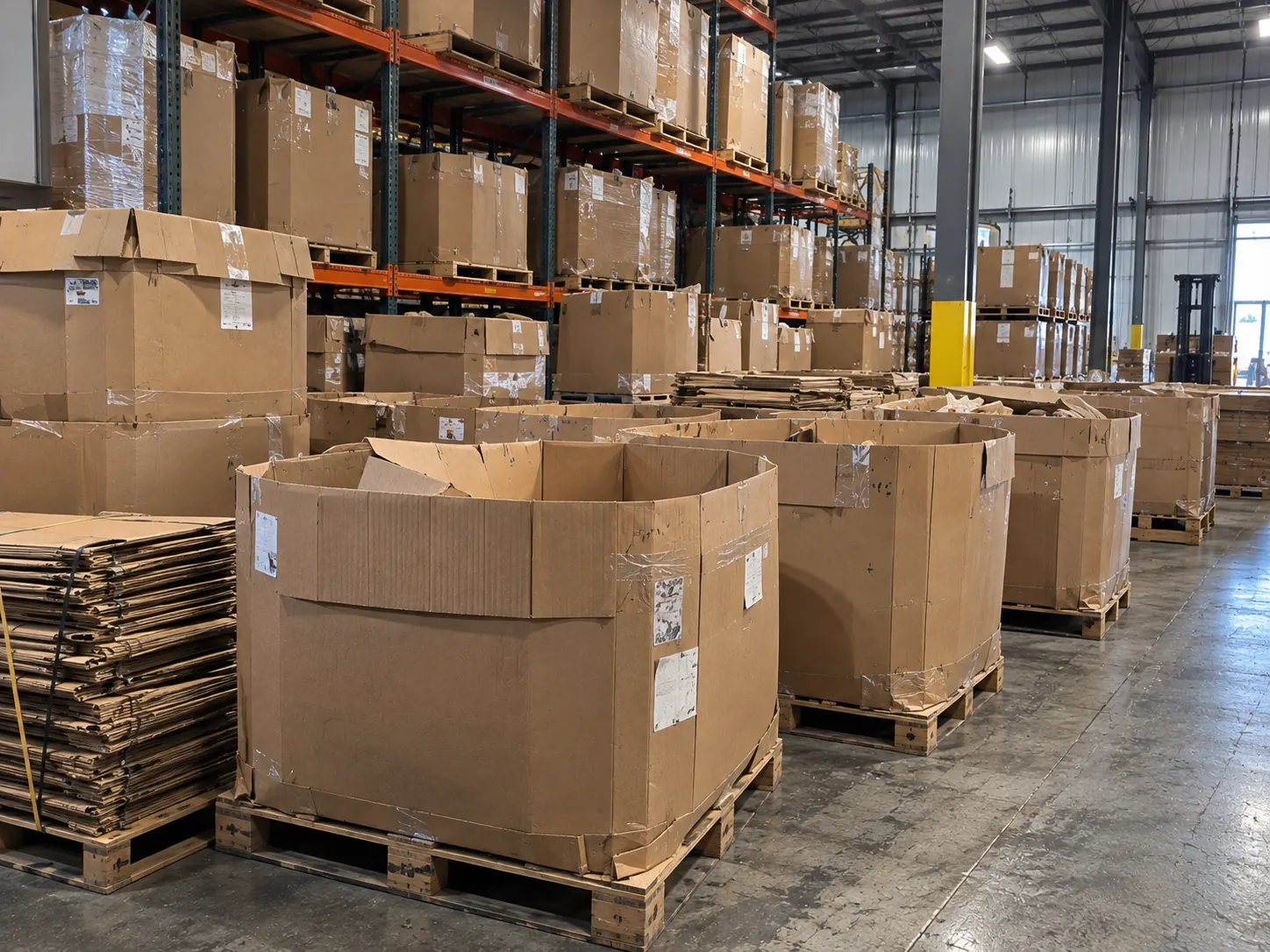
A trailer at sixty per cent costs the same to run as one at ninety-five.
We measured the loaded cube of every outbound trailer for a quarter. A third left below 75 per cent, and the largest single cause was not geometry — it was a fixed delivery date.