Gaylord boxes
The big ones. Triple-wall bulk containers sized to a GMA pallet, graded A through C, sold by the pallet or the truckload with lids, liners and bottoms to match.
Quote gaylord boxes
Give us a size and a count and we will photograph the actual pallet before you commit.
- Common size
- 48" × 40" × 36"
- Wall
- Triple wall, 1,100 lb test
- Grades
- A / B / C, sorted by hand
- Minimum
- 1 pallet (20 – 24 boxes)
- Sorted and inspected flap-by-flap before it leaves the yard
- Lids, full-depth liners and separate bottoms available
- Knocked down and banded flat for freight efficiency
- Buy-back programme on qualifying lanes
Work out the cube before you ask for a price.
Box Studio gives you the erected cube, the knocked-down cube, the pallet fit and the trailer count for any size — then attaches the spec to the form above.
What we hold, and what each size is actually for.
Gaylord is a loose word. These are the footprints we keep in graded stock; anything else we will source or build.
| Size | Dimensions | Wall | Capacity | Cube | Typical use | Grades |
|---|---|---|---|---|---|---|
| Standard | 48" × 40" × 36" | Triple wall | 1,800 – 2,200 lb | 40.0 ft³ | General bulk, OCC collection | A / B |
| Low-side | 48" × 40" × 30" | Triple wall | 1,600 – 2,000 lb | 33.3 ft³ | Dense scrap, metal turnings | A / B |
| Mid | 48" × 40" × 34" | Triple wall | 1,800 lb | 37.8 ft³ | Automotive parts, castings | B |
| Tall-standard | 48" × 40" × 39" | Triple wall | 1,900 lb | 43.3 ft³ | Mixed distribution bulk | A / B |
| Tall | 48" × 40" × 44" | Triple wall | 1,800 – 2,200 lb | 48.9 ft³ | Textiles, foam, light bulk | A / B / C |
| Extra-tall | 48" × 40" × 48" | Triple wall | 2,000 – 2,400 lb | 53.3 ft³ | Returns processing, apparel | B / C |
| Column | 48" × 40" × 52" | Triple wall + corner posts | 2,000 lb | 57.8 ft³ | Light, high-cube consolidation | B |
| Harvest | 48" × 40" × 60" | Triple wall + liner | 2,200 lb | 66.7 ft³ | Hemp, tobacco, light agriculture | A |
| Wide | 48" × 44" × 36" | Triple wall | 2,000 lb | 44.0 ft³ | Produce, agricultural bulk | A / B |
| Produce | 48" × 45" × 34" | Triple wall, vented | 1,900 lb | 42.5 ft³ | Field-pack produce with ventilation | A |
| Pallet-flush | 40" × 48" × 40" | Double wall | 1,200 – 1,500 lb | 44.4 ft³ | Light consolidation | B |
| Octabin | 41" × 41" × 45" | Double / triple wall (8-sided) | 2,000 – 2,800 lb | 43.7 ft³ | Resin pellets, powders, free-flow | A / B |
| Octabin | 41" × 41" × 38" | Triple wall (8-sided) | 2,400 lb | 36.9 ft³ | Dense granulate, minerals | A / B |
| Tall octabin | 41" × 41" × 53" | Double wall (8-sided) | 2,000 lb | 51.5 ft³ | Low-density powders, flake | B |
| Compact | 36" × 36" × 36" | Double wall | 900 – 1,200 lb | 27.0 ft³ | Half-pallet bulk, e-comm returns | B / C |
| Compact tall | 36" × 36" × 45" | Double wall | 1,000 lb | 33.8 ft³ | Retail backroom consolidation | B / C |
| Half-pallet | 32" × 30" × 36" | Double wall | 800 lb | 20.0 ft³ | Store-level display and bulk | B |
| Mini bulk | 30" × 30" × 30" | Double wall | 700 lb | 15.6 ft³ | Samples, kitting, shop floor | B |
| Quarter bin | 24" × 20" × 21" | Double wall | 350 lb | 5.8 ft³ | In-plant totes, work-in-progress | B / C |
| Shallow | 48" × 40" × 24" | Triple wall | 1,500 lb | 26.7 ft³ | Very dense scrap, swarf, offcuts | A / B |
Why a reconditioned gaylord beats a new one
A new triple-wall container arrives perfect and then takes its first forklift strike within a fortnight. After that, both containers are “used”. The difference is that ours has already been inspected, repaired where needed, and graded by somebody whose job is to find the weak panel.
At our median of nine trips, a reconditioned gaylord costs roughly a seventh of a new one per use. The limiting factor is almost never the board — it is handling. Which is why we will talk to you about your forklift drivers before we talk to you about wall construction.
What comes with it
Lids and separate bottoms matched to the size, full-depth poly or foil liners, corner boards, and strapping. A separate lid rather than repeatedly folded flaps is the cheapest life-extension available — it adds two to three trips on its own.
On qualifying lanes we will buy the same containers back at end of life, which means your disposal cost disappears and the pool stays in circulation. Ask for terms when you quote.
Going deeper
Five specifics.
Is 'gaylord' a size or a type?
Neither, strictly. It is a generic term for a pallet-sized bulk corrugated container, from a brand name that became common usage. In practice most people mean a 48 × 40 × 36 triple-wall box. Always quote dimensions rather than the word.
What is the real capacity?
Our standard triple-wall carries 1,800 – 2,200 lb depending on load distribution and whether it is lidded and strapped. Tested static load on a properly stacked unit reaches 2,400 lb. Dense material such as metal turnings should go in a low-side 30-inch box, not a tall one.
Do you sell them erected or knocked down?
Knocked down and banded, unless you specifically need them erected. Knocked down fits roughly twenty times more per trailer — Box Studio shows the exact ratio for your size.
Can they be lined for food or hemp?
Yes. FDA-compliant poly and foil liners, plus odour-barrier options for hemp and cannabis biomass. The liner carries the compliance claim, not the board.
What is the minimum?
One pallet, which is typically 20 – 24 knocked-down containers. Below that, freight usually makes the whole thing uneconomic and we will say so.
Eight decks, and what sits on them.
Specify your container to the pallets you actually own, not to the standard. A 48 × 40 GMA pallet in the real world runs anywhere from 47.5 to 48.5 inches.
| Footprint | Construction | Typical use | Note |
|---|---|---|---|
| 48" × 40" GMA, 4-way | Stringer, notched | North American standard | Real examples run 47.5 – 48.5 inches. Measure yours. |
| 48" × 40" block | Block, 4-way true | Automated handling | Better for AS/RS and robotics |
| 48" × 48" drum | Stringer | Chemical, octabins | Suits the 41-inch octabin footprint |
| 42" × 42" | Stringer | Beverage, telecom | Common in soft-drink distribution |
| 48" × 45" | Stringer | Produce field pack | Matches vented produce bins |
| 36" × 36" half | Block | Retail display | Store-level display base |
| 1200 × 1000 mm | Block | International | The closest metric equivalent to GMA |
| 1200 × 800 mm EUR | Block | Europe | Too narrow for most US bulk containers |
| Pattern | Compression retained | Stability | Wrap needed | Use when |
|---|---|---|---|---|
| Column (aligned) | Up to 100% | Low | Required | Heavy uniform loads into racking |
| Brick (offset rows) | ~60% | Good | Recommended | Mixed weight, manual handling |
| Pinwheel | ~60 – 70% | Highest | Recommended | Odd footprints with a centre void |
| Full interlock | ~45% | Highest | Optional | Light loads where toppling is the risk |
Eleven liners, and what each one is actually for.
For most bulk applications the liner matters more than the board. It carries the moisture barrier, the food-contact claim and — for powders — the static behaviour.
| Type | Gauge | Barrier | Relative cost | Suited to | Note |
|---|---|---|---|---|---|
| Standard poly | 2 – 4 mil | Moisture | 1.0× | Resin pellets, granulate, general bulk | Clear, so fill level is visible from outside |
| Heavy poly | 6 mil | Moisture, puncture | 1.6× | Sharp or abrasive granulate | Resists puncture from angular material |
| Antistatic poly (topical) | 4 mil | Moisture, static | 1.4× | General dust control | Stops working below ~30% relative humidity |
| Antistatic poly (permanent) | 4 mil | Moisture, static | 2.1× | Dry or heated facilities | Additive integral to the film; humidity-independent |
| Static dissipative | 4 – 6 mil | Controlled discharge | 3.0× | Electronics feedstock | Needs a verified grounding path to work |
| Conductive / Type C | 6 mil | Grounded discharge | 4.2× | Combustible dust | Only safe as part of a bonded, grounded system |
| Foil laminate | — | Moisture, light, vapour | 3.4× | Humidity-sensitive powders | Opaque; fill level needs a separate check |
| Multi-layer odour barrier | — | Moisture, odour | 3.8× | Hemp, cannabis, aromatics | EVOH or metallised layer; plain poly will not do this |
| FDA-compliant poly | 2 – 6 mil | Moisture, food contact | 1.3× | Food ingredients, pet food | Supplied with a letter of guarantee |
| Spouted liner | 4 mil | Moisture | 1.9× | Gravity discharge lines | Bottom spout; halves emptying time |
| Vented liner | 2 mil | Partial | 1.5× | Respiring produce and biomass | Closed but not sealed — stops internal humidity build-up |
Eight failure modes, coded from our own retirements.
Ordered by share of retired containers. Note how few are repairable, and how many are prevented by something that costs almost nothing.
| Failure mode | Share | Repairable? | What prevents it |
|---|---|---|---|
| Forklift tine strike, lower long panel | 31% | Rarely | Floor approach guides, full-deck pallets, slower pick-face speed |
| Moisture through the flutes | 26% | No | Pallets not concrete, covered storage, let cold trailers equalise |
| Top-edge crush | 18% | Sometimes | Telescoping lids on anything stacked or racked |
| Strapping cut at the corner | 9% | Sometimes | Corner boards — the cheapest fix on this list |
| Corner rounding from over-stuffing | 7% | No | Do not fill above the top score line; buy the taller box |
| Cracked score lines | 5% | Yes, re-score | Separate lids instead of repeatedly folded flaps |
| Manufacturer's joint failure | 3% | Yes | Prefer stapled joints over glued for reuse |
| Delamination | 1% | No | Moisture control; there is no other cause worth chasing |
Seven repairs, and the limits of each.
Just as important as what a bench can fix is what it cannot. A repaired box that fails is worse than a baled one, and attempting the impossible repairs is how a yard destroys its own grade scale.
| Operation | Bench time | Life recovered | Material | Limit |
|---|---|---|---|---|
| Flap splice | 3 – 5 min | 2 – 4 trips | Recovered board offcut | Not viable past two missing flaps |
| Patch panel | 6 – 9 min | 3 – 5 trips | Recovered board offcut | Cannot patch a load-bearing vertical corner |
| Re-scoring | 2 – 3 min | 2 – 3 trips | None | Will not square a rounded corner |
| Edge reinforcement | 5 – 7 min | 3 – 4 trips | Recovered board strip | Needs sound board either side |
| Label & residue removal | 2 – 6 min | Appearance | Minimal | Heavy residue needs blank-out print |
| Blank-out printing | 1 – 2 min | Appearance | Ink | Single colour only |
| Corner post insertion | 8 – 12 min | 4 – 6 trips | Laminated board post | Only on triple wall |
Height is a density decision, not a volume one
This is the single most useful rule on the subject and it is routinely got backwards. Tall containers are for light material; low containers are for heavy material. A 44-inch gaylord filled with metal turnings reaches its weight limit at a third of its cube and then fails at the corners because the load is concentrated low and the walls are tall. A 30-inch low-side box carries the same weight safely and costs less.
Run the density first. Under about 12 lb per cubic foot, go tall and buy cube. Over about 60, go low-side and buy strength. Between the two, the standard 36-inch box is the standard for a reason.
Inside, outside and the inch that ruins a pallet fit
Corrugated is always quoted as inside dimensions, because that is what your product has to fit into. Triple wall adds roughly five-eighths of an inch of board per side, so 1.25 inches on every axis. A container specified at 48 inches inside measures about 49.25 outside — and a 48 × 40 GMA pallet in the real world runs between 47.5 and 48.5 inches.
That mismatch is why so many 'flush' gaylords overhang, and an overhanging container takes a hit on every rack move for the rest of its life. Specify to the pallets you own, measured, not to the standard.
The three components people skip
- A telescoping lid. Protects the top edge from rack and forklift contact and removes repeated flap folding. Worth two to three trips on our own data.
- A separate bottom tray. Takes vertical load off the sleeve for dense or sharp material, and lifts the sleeve's cut edge clear of the pallet deck where wicking starts.
- Corner boards. Lets you apply proper strap tension without crushing the corners that carry the whole load.
Together they cost a fraction of the sleeve and roughly double its working life. We sell far fewer of them than we should, and the reason is almost always that nobody thought about it rather than that anybody decided against it.
Nine things to read in the photograph.
Buying used bulk containers from four photographs is normal in this trade. These are what to look at, ranked by how well each predicts a problem on arrival.
Bottom-left of the long panel
Where forklift tines land. Soft, fuzzed or delaminated board here means the container will fail under load regardless of how good the rest looks.
Corner squareness
If the vertical corners bow outwards the box has been over-stuffed and the score lines are permanently rounded. It will not stack.
Liner colour variation
Patchy darkening, especially in horizontal bands, means moisture cycling. The flutes underneath have softened even if the surface looks dry.
Flap edges
Fuzzed and feathered means repeated opening and closing, near end of life. Clean cuts with light scuffing means plenty left.
What is underneath
Bare ground or grass in the photograph means wicking at the base course. Ask for a picture of the bottom container specifically.
Print bleed-through
Indicates thin liner on a reused shipper, which usually means it has been through more cycles than claimed.
The manufacturer's joint
Staples survive reuse better than glue. A stapled joint is a quiet plus.
Score lines
Visibly cracked rather than creased will split on the next fold.
The count
'Approximately a pallet' is not a quantity. A pallet of gaylords is 20 to 24 depending on wall and size.
Gaylords, in detail.
How much does an empty gaylord weigh?
A 48 × 40 × 36 triple-wall sleeve is about 18.5 lb of board. A telescoping lid adds roughly 6 lb and a bottom tray about 7. That matters on weight-constrained lanes and in your manual handling assessment.
How many fit on a trailer?
Erected, about 62 in a 53-foot van at realistic packing efficiency. Knocked down and banded, about 534. That 8.6× ratio is the single biggest lever on the delivered cost of bulk containers.
Can gaylords be stacked in racking?
Lidded and strapped, two high is routine on a 2,400 lb rated container. Unlidded, no — the top edge takes the beam load directly and crushes. The lid is a structural member, not an accessory.
What is the real capacity?
1,800 – 2,200 lb for a standard triple-wall unit depending on load distribution, lidding and strapping. Tested static load on a properly stacked unit reaches 2,400 lb. Dense material belongs in a low-side box, not a tall one.
How many times can one be reused?
Median nine round trips on our marked-container data, top decile fourteen, bottom decile four. The spread is almost entirely handling: tine strikes, moisture, over-stuffing and strapping without corner protection.
Do you take them back?
On qualifying lanes, yes — a buy-back arrangement means your disposal cost disappears and the containers stay in circulation. Ask for terms when you quote, because it changes the total cost materially.
What the rack does to the box.
Container specification and racking choice are the same decision made twice. Drive-in and push-back racking are where we see the most container damage, because the container is handled blind.
| Rack type | Beam span | Load capacity | Effect on containers |
|---|---|---|---|
| Selective pallet rack | 96 – 144" | 2,500 – 6,000 lb/level | Most common; one pallet deep |
| Double deep | 96 – 108" | 2,500 – 5,000 lb/level | Needs a reach truck; container squareness critical |
| Drive-in | N/A, rails | 2,000 – 4,000 lb/pallet | Container damage risk is highest here |
| Push-back | 96 – 120" | 2,200 – 4,500 lb/pallet | Dynamic load; overhang is unforgiving |
| Pallet flow | 96 – 120" | 2,000 – 3,000 lb/pallet | Bottom-board condition decides whether it rolls |
| Floor stacking | N/A | Board-limited | Where box compression strength actually binds |
| Item | Limit | Note |
|---|---|---|
| Single-person lift, ideal zone | Up to 35 lb | Between knuckle and shoulder height, close to the body |
| Single-person lift, absolute | 50 lb | Common carrier and insurer threshold for cartons |
| Two-person lift | Up to 100 lb | Requires clear path and matched heights |
| Carton max gross, 32 ECT | 65 lb | Certificate limit, not a handling recommendation |
| Carton max gross, 48 ECT | 120 lb | Mechanical handling expected |
| Gaylord, loaded | 1,800 – 2,400 lb | Forklift or pallet truck only |
| Pallet jack, manual | 5,500 lb | Flat floors only |
| Counterbalance forklift, typical | 5,000 lb at 24" load centre | Derates sharply as load centre moves out |
Five levels, and what each is good for.
No level of cleaning makes a used corrugated container suitable for direct food contact. What it does is make a container acceptable for its actual application, which is a different and answerable question.
| Level | Method | Suited to |
|---|---|---|
| Visual inspection only | Grading station check for residue and odour | General industrial, scrap, internal moves |
| Vacuum and blow-down | Compressed air and industrial vacuum | Resin, granulate, dusty materials |
| Label and residue removal | Mechanical removal at the re-face station | Anything customer-facing |
| Liner barrier | New FDA-compliant liner each cycle | Food ingredients, pet food, produce |
| Secure destruction | Shredding and baling with certification | Branded or regulated containers |
Seven things about your dock that change the quote.
Declared before the quote these are free to plan around. Discovered on delivery day they are the single most common reason a cheap quote becomes an expensive invoice.
| Item | Specification | Why it matters |
|---|---|---|
| Dock height | 48 – 52" typical | Below 44" a standard trailer needs a leveller or a ramp |
| Dock leveller capacity | 20,000 – 30,000 lb | Loaded gaylords on a pallet truck approach the limit |
| Door width | 8 – 9 ft | Double-stacked knocked-down bundles are wide |
| Apron depth | 100 – 130 ft | A 53-foot trailer needs room to square up |
| Liftgate requirement | If no dock | Add $75 – $150; declare it before the quote, not after |
| Receiving window | 3-day window ideal | Lets us consolidate; worth more than a volume discount |
| Forklift availability | 3,000 lb minimum | A loaded gaylord plus pallet exceeds many electric walkies |
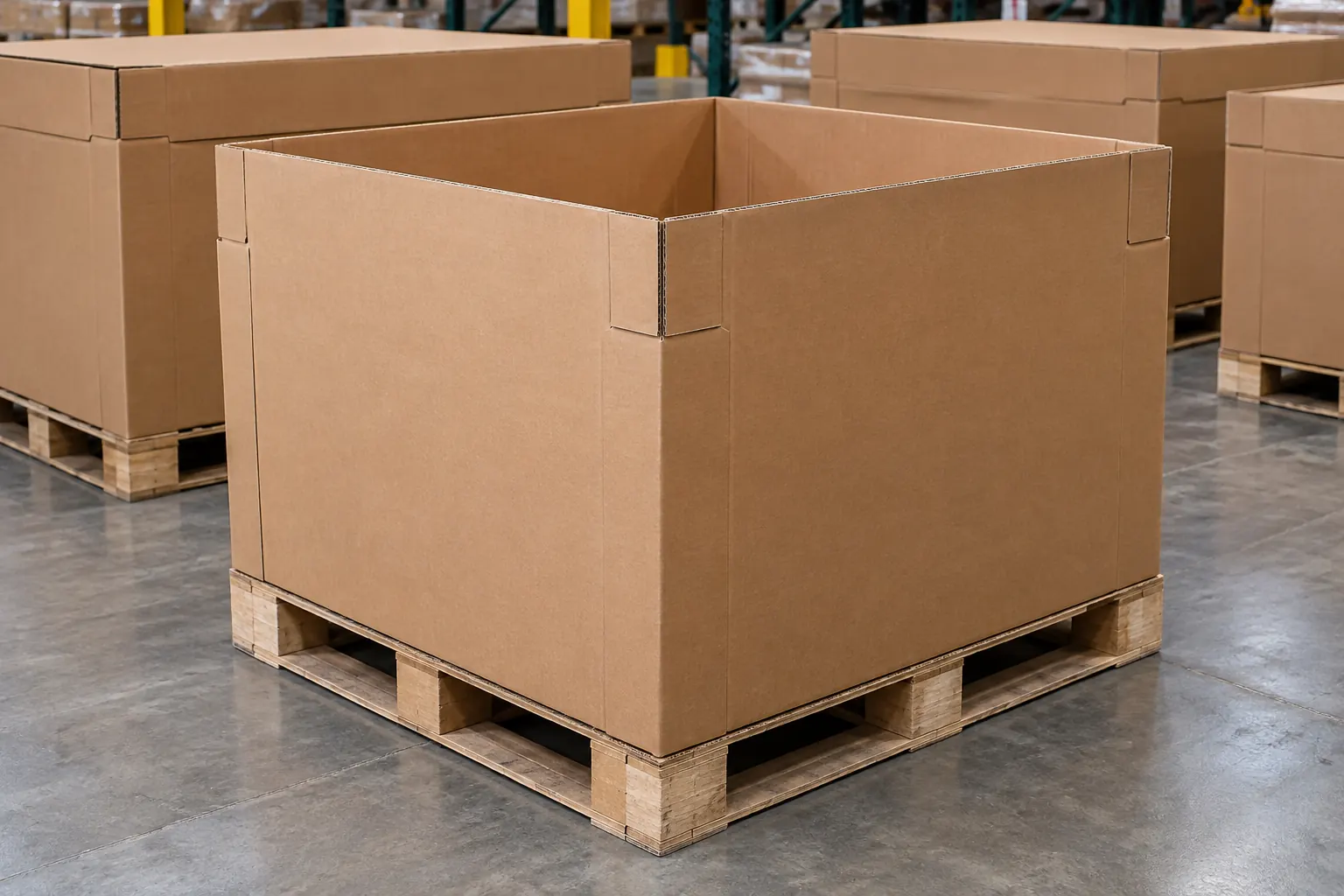
Light creasing on one panel. Six or seven trips left.
Minor surface scuffs, light creasing, clean interior, all flaps intact and fully functional. This is our volume product and the grade most buyers should be specifying for anything that stacks in a rack.
Look at the bottom third of the long panel in this photograph — that is where forklift tines land, and it is the first thing a grader checks, ahead of everything more visually obvious.
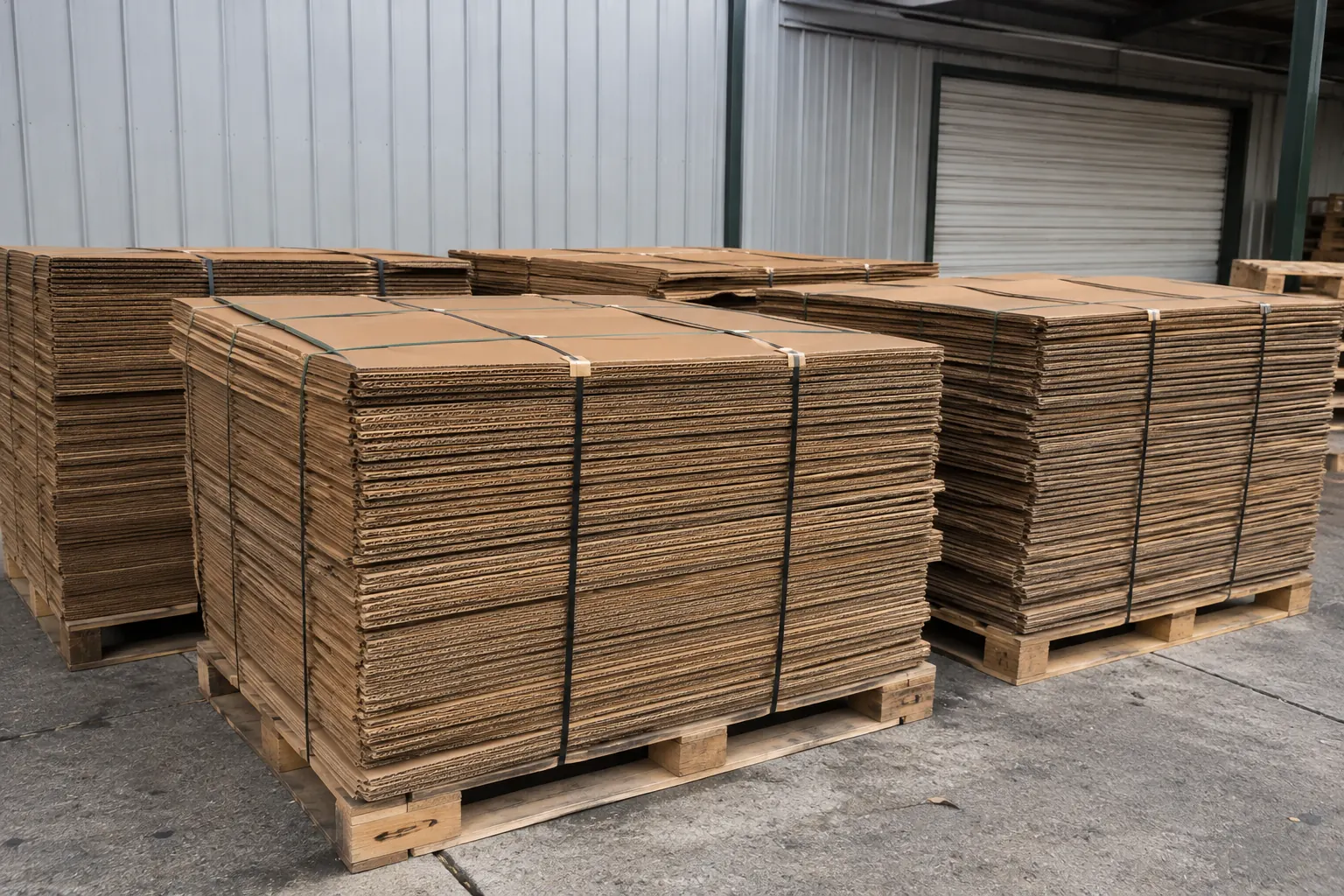
Banded, stacked and cube-checked before anything moves.
Knocked-down board rides alongside erected containers on the same pallet position. A trailer leaving at sixty per cent utilisation costs the same to run as one at ninety-five.