One yard in St. Louis. Fifty states of lanes out of it.
Everything ships from 9869 Meeks Blvd. What changes by location is the freight — the mode, the transit time and whether reuse beats buying new on your particular lane. We are candid about all three.
Check your lane
Give us a postal code and we will tell you the zone, the mode and what it costs.
- Zone 1 — own trucks — 2 states
- Zone 2 — scheduled milk runs — 13 states
- Zone 3 — truckload lanes — 20 states
- Zone 4 — nationwide truckload — 16 states
Beyond roughly 900 miles, LTL on low-density freight usually makes reuse uneconomic. We will tell you that rather than quote it and let you discover it on the invoice.
What the zone actually changes.
Not the product, and not the grading standard. Only the freight — and on empty corrugated, freight is most of the decision.
| Zone | Quote | Collection | Delivery | Modes available | States |
|---|---|---|---|---|---|
| Zone 1 — own trucks | Same business day | Same or next day | Same or next day | Own trailers, drop trailers, live load | 2 |
| Zone 2 — scheduled milk runs | Same business day | On the weekly route | 2 – 4 days | Milk run, partial truckload, drop trailer | 13 |
| Zone 3 — truckload lanes | One business day | Scheduled, 5 – 10 days | 3 – 6 days | Full and partial truckload, LTL on small orders | 20 |
| Zone 4 — nationwide truckload | One business day | By arrangement | 5 – 9 days | Full truckload only | 16 |
own trucks
Zone 1 — our own trucks. Same-day and next-day collection and delivery, drop trailers on standing accounts.
scheduled milk runs
Zone 2 — scheduled milk runs. Weekly recurring routes that collect and deliver on the same pass.
truckload lanes
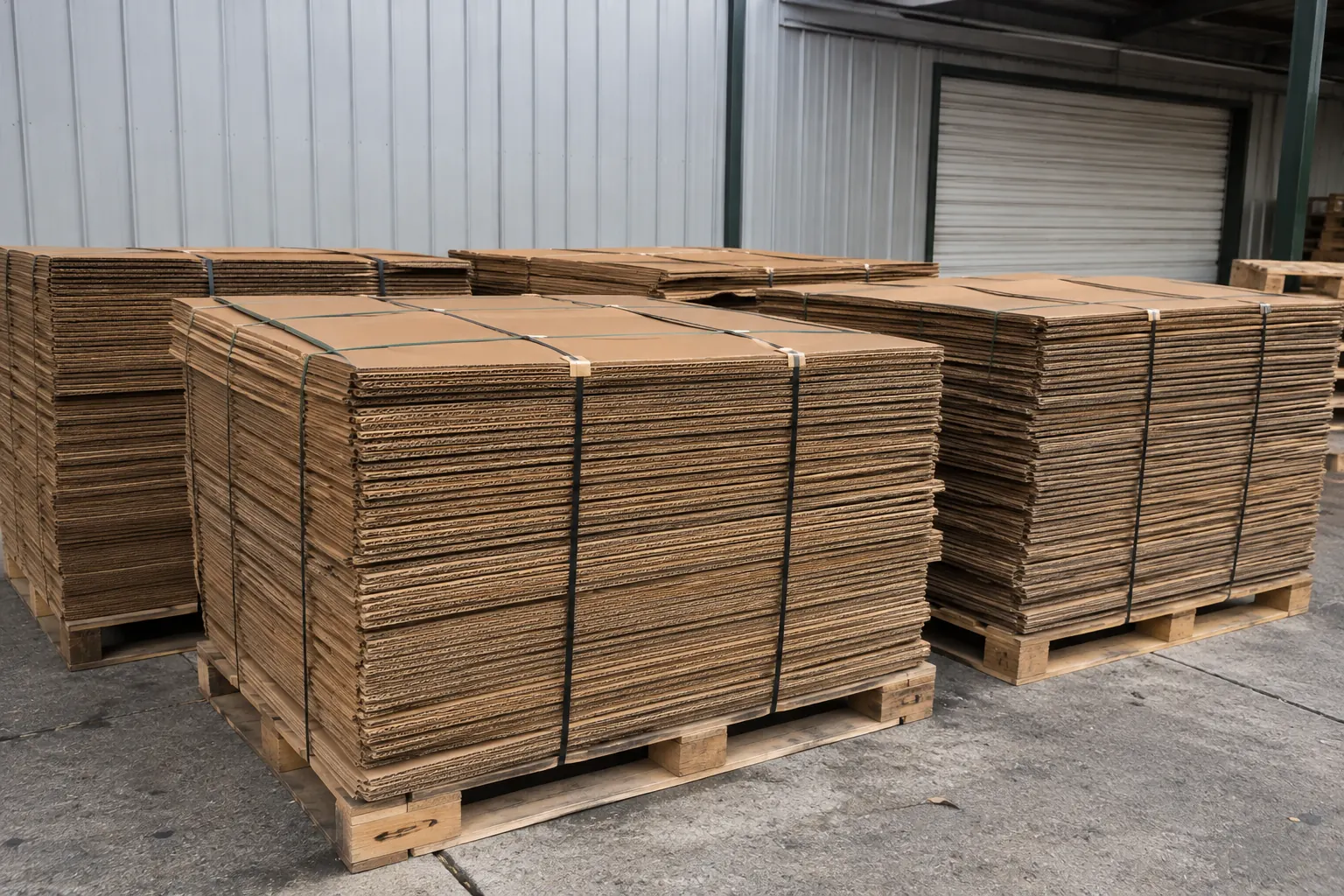
Zone 3 — truckload lanes. Full and partial truckload, knocked down and banded for cube efficiency.
nationwide truckload
Zone 4 — nationwide truckload. Full truckload only; we will tell you plainly if freight makes reuse uneconomic.
Midwest
The Midwest is our home market and the densest part of our network. Manufacturing, agriculture and distribution all generate used corrugated here in volume, which means supply and demand sit close together and freight stays short.
South
The South runs on distribution centres, food processing and a long agricultural season. Demand for lined bulk containers peaks hard in late summer, and the return flow of used board peaks in the first quarter.
Northeast
The Northeast is dense, expensive to move freight through, and generates a lot of high-grade used corrugated from retail and e-commerce. Full truckload almost always beats LTL here once you are past a few pallets.
West
The West is a truckload market from St. Louis. Long lanes mean we are candid about when reuse stops making economic sense, and we will say so rather than quote a number that only works on paper.
Six questions about where we ship.
Do you really ship to all fifty states?
Full truckload, yes, anywhere in the continental US. Alaska and Hawaii are possible but we will be frank that freight usually makes used packaging uneconomic against local supply, and we would rather say so than take the order.
What changes between zones?
The freight mode and the transit time. The product, the grading standard and the way we quote do not change at all — a grade B box in Zone 4 is graded by the same person against the same written scale as one going across town.
Can you collect as well as deliver?
In Zones 1 and 2 routinely, often on the same pass, which halves both the cost and the carbon. In Zone 3 by arrangement on truckload lanes. In Zone 4 only where the volume justifies a dedicated trip.
Do you have other locations?
No, and that is deliberate. Everything — inbound, grading, repair, conversion, baling and outbound — happens in one building. Reuse margins do not survive being trucked between three sites, so we accept a geographic limit instead.
How is freight priced?
We quote delivered, with freight shown separately and the cube arithmetic attached. On low-density freight an FOB price tells you almost nothing useful.
What if I am right on a zone boundary?
Tell us the postal code and we will quote both ways. Boundaries move with fuel, season and lane direction, so the map is a guide rather than a rule.
Every mile on this page is measured from one loading dock: 9869 Meeks Blvd, St. Louis, MO 63132.
St. Louis sits within a day’s drive of roughly a third of the US population, which is the main reason this business works from here rather than anywhere else. Nine trailers, three of them drop units, run the recurring Midwest routes.
St. Louis sits within a day's drive of a third of the US population.
That is the main reason this business operates from here rather than somewhere cheaper. Nine trailers, three of them drop units, run the recurring Midwest routes.