Sell us your boxes
If boxes leave your building flat, baled, or in a dumpster, you are paying twice. We buy clean used corrugated and gaylords, bring our own trailer, and pay on pickup.
Start: sell us your boxes
Pre-filled for this service. Add the detail and it reaches the floor.
Just email us a photo.
One picture of the stack, with a tape measure in it if you can manage, and a rough count. That is genuinely all we need to give you a number.
Weigh ticket or piece count — your choice, agreed before we arrive. Paid on pickup or net-7. We do not do “we will let you know what it made at the mill”.
Four steps, in this order, every time.
Send a photo
One picture of the stack tells us more than a spreadsheet. Include a tape measure if you can.
Get a number
We price by grade, size run and volume, and tell you plainly when baling beats resale.
We bring the trailer
Drop trailer, live load or scheduled milk-run — whatever suits your dock.
Paid on pickup
Weigh ticket or piece count, your choice. Net-7 or on-the-spot.
Turn a disposal cost into a cheque.
Everything here happens out of one building at 9869 Meeks Blvd, St. Louis. That is not a detail — it is the only reason the numbers work.
And, more usefully, what we will not.
Being clear about this saves you a photograph and us a trailer.
- Triple-wall gaylords, any grade, lidded or not
- Used RSC shippers 10" to 40", sorted or unsorted
- Octabin sleeves, liners removed
- Double-wall bulk bins and trays
- Recovered GMA pallets, including repairable ones
- Baled OCC, mill grade #11 and #12
- Clean flat corrugated off a store or DC backroom
- Wax-coated produce board — no viable outlet
- Anything with food residue that cannot be separated
- Heavily laminated or foil-faced stock
- Board stored outdoors and visibly water-damaged through
- Containers with hazardous-material markings still attached
- Mixed waste with corrugated in it — that is a hauler's job, not ours
If you are not sure which side of the line your material falls, send the photo anyway. We would rather look than guess.
Sometimes baling pays you more than selling to us.
It depends on the OCC market, your volume and your labour cost. We will run both numbers and tell you which is better, even when the answer is not us.
| Situation | Usually better | Why |
|---|---|---|
| Matched sizes, grade A/B, 500+ units | Resale to us | The sorting value is already captured — you are selling a product, not a commodity |
| Mixed sizes, mostly grade C | Baling | Sorting cost exceeds the resale premium; commodity pricing wins |
| Gaylords, any grade, any volume | Resale to us | Triple wall is always worth more as a container than as fibre |
| High volume, no space, no labour | Baler on site | We will place equipment and buy the bales |
| Seasonal spike, three weeks a year | Scheduled collection | Neither — we just come more often with a drop trailer |
| OCC market at a cyclical high | Baling, briefly | We will say so, and we will tell you when it turns |
What a bale is worth, and why.
Old Corrugated Containers is a traded commodity with published indices and a long history of violent swings. If you sell baled OCC without watching it, you are guessing.
| Grade | Specification | Moisture | Premium | Who buys it |
|---|---|---|---|---|
| ISRI #11 — OCC | Sorted, baled corrugated. Up to 5% prohibitives, 5% other paper. | ≤ 12% | Baseline | Domestic containerboard mills |
| ISRI #12 — Double-sorted OCC | Double-sorted, ≤1% prohibitives. New corrugated cuttings excluded. | ≤ 10% | +15 – 30% | Mills running recycled liner |
| ISRI #13 — New corrugated cuttings | Unused box plant trim, no print or wax. | ≤ 10% | +40 – 60% | High-grade liner mills |
| Mixed paper | Unsorted paper grades including corrugated. | ≤ 12% | −40 – 70% | Varies; occasionally a disposal cost |
| Wet or contaminated | Outside specification on moisture or prohibitives. | > 15% | Rejected or deducted | Nobody |
The nine points, in the order a grader checks them.
Ordered by how well each point predicts failure under load, not by how obvious it is. The first one is the least visible and the most important.
| # | What is checked | What disqualifies | Downgrades to |
|---|---|---|---|
| 1 | Bottom third of the long panel | Soft, fuzzed or delaminated board from tine strikes | Recovery |
| 2 | Vertical corner squareness | Corners bowed outward from over-stuffing | C, or recovery if severe |
| 3 | Liner colour banding | Patchy darkening indicating moisture cycling | Recovery |
| 4 | Flap edge condition | Fuzzed or feathered edges; missing flap corners | C, or bench repair |
| 5 | Score line integrity | Cracked rather than creased folds | C, or bench re-score |
| 6 | Manufacturer's joint | Separated glue line or pulled staples | Bench repair |
| 7 | Interior cleanliness | Residue, dust, previous product traces | C |
| 8 | Print and label residue | Heavy multi-colour print or continuous tape bands | B at best; re-face station |
| 9 | Top edge crush | Crushing on stacked or racked units | Bench reinforcement, else C |
The strength you lose, and never get back.
Board that has been to 20% moisture and dried back to 9% does not recover its original strength. The damage is permanent and invisible — the box looks fine and fails at a load it used to carry.
| Moisture content | Edge crush retained | What it means | What we do |
|---|---|---|---|
| 6 – 8% | 100% | Specification condition, as tested at the mill | Nothing |
| 10% | ~90% | Normal conditioned warehouse | Nothing |
| 12% | ~80% | Noticeable softening; stacking margin eroding | Reduce stack height |
| 15% | ~60% | Do not stack; one more cycle at best | Grade down to C |
| 18% | ~45% | Structural life effectively over | Bench or baler |
| 20%+ | ~35% | Finished, even after drying back | Baler |
What we will put on your site, and when it is worth it.
Thresholds move with labour cost and OCC price. Below two tons a month a baler will never pay back, and we will say so rather than place one.
| Monthly OCC volume | Recommended | Capital | Why | Serviced by |
|---|---|---|---|---|
| Under 2 tons / month | Gaylord collection points | None | A baler will never pay back at this volume | We collect on a milk run |
| 2 – 8 tons / month | Vertical baler | Low | Small footprint, manual tie, low capital | Us, quarterly |
| 8 – 25 tons / month | Horizontal baler, manual tie | Medium | Throughput without a dedicated operator | Us, monthly |
| 25 – 60 tons / month | Horizontal auto-tie | High | Continuous feed, consistent bale weight | Us, monthly |
| 60+ tons / month | Auto-tie plus compactor swap | High | Mixed stream handling alongside OCC | Us plus your hauler |
| Seasonal spike only | Drop trailer | None | No capital at all — a box on wheels | Us, on schedule |
What your material is actually worth
There are two completely different numbers attached to a stack of used corrugated, and the gap between them is large. As a container it is worth several dollars a unit. As fibre it is worth a few cents a pound. Which number applies depends almost entirely on condition and sortability, and most sellers have never had anybody look at it from the first angle.
On a typical inbound stream from a dock that has been baling everything, roughly 18% is still a usable container. That 18% is the part you have been selling at commodity pricing.
The photograph
One picture of the stack tells us more than a page of description. Put a tape measure in frame if you can. We are looking at four things: whether the stack is on pallets or on concrete, whether there is any colour banding on the liner, how square the corners look, and what is sitting underneath. Those four answer most of the pricing question before anybody has measured anything.
How we pay
- Weigh ticket or piece count — your choice, agreed before we arrive rather than after.
- On pickup, or net-7. Never 'we will let you know what it made at the mill'.
- Deductions, if any, explained with the reason and the quantity, not applied silently.
- A written grade breakdown so you can see what you actually sold.
When we tell you not to sell to us
If your material is mostly grade C in mixed sizes, the sorting cost exceeds the resale premium and baling will genuinely pay you more. We run both numbers and say so. If the OCC market is at a cyclical high, we say that too, and we tell you when we think it is about to turn. Losing a load occasionally is cheaper than acquiring a reputation for only being honest when it suits us.
Eight things that decide the number.
In roughly the order they affect price. The first three are almost entirely about how the material was stored, not what it was originally.
Storage history
On pallets under roof, or on concrete, or outside. This single fact moves the price more than the original board specification.
Moisture
Colour banding on the liner and a tide line where wicking stopped. Board that has been to 18% does not come back.
Size consistency
One size is a product. Nine sizes is a sorting job, and sorting is what you are selling us.
Grade distribution
What proportion is A, B and C. We will grade a sample and tell you the split before committing to a number.
Contamination
Film, foam, tape, food residue and wax. Each has a different consequence and wax is the only fatal one.
Count accuracy
'Approximately a pallet' is not a quantity. A real count gets you a firmer price.
Loading method
Drop trailer, live load or milk run. Your dock constraints change our cost and therefore your price.
Volume and regularity
A recurring weekly stream is worth more per unit than the same tonnage once a year, because we can plan grading capacity around it.
Selling, in practice.
Do I need to sort it first?
No, but sorting raises the price because it removes our largest cost. If you have idle labour and floor space, sorting into size runs before we collect is usually worth more than you expect. If you do not, send it as it is and we will price the sorting into the number.
What if the load is not what I described?
We grade on arrival and contact you before processing anything that differs materially from the description or photographs. We do not adjust the price unilaterally and then tell you afterwards.
Will you take one pallet?
Within our own truck radius, often yes, especially if we are passing. Further out the collection freight exceeds the material value and we will say so rather than make a trip that costs us both money.
Can you place equipment on site?
Yes — gaylord collection points, vertical or horizontal balers, or a drop trailer for seasonal spikes. The right answer depends on your monthly tonnage, and below about two tons a month the answer is 'none of the above'.
Do you buy from MRFs and haulers?
Regularly. Pre-bale sorting arrangements let us take the reusable fraction before it becomes a commodity, which is worth more to you than the bale price on that material. It is one of our better partnerships.
What about containers with our branding on them?
We can blank out print at the re-face station, or destroy marked containers securely and certify it if your brand protection requires that. Tell us which before collection.
What comes off each machine, and how many fit a trailer.
Mills price on consistency as much as on grade. Auto-tie machines produce the most uniform bale weight, which is why they attract a better number per ton than their throughput alone would justify.
| Baler | Typical bale size | Bale weight | Bales per trailer | Note |
|---|---|---|---|---|
| Vertical, small | 60 × 30 × 48" | 500 – 800 lb | 40 – 48 | Manual tie, lowest capital |
| Vertical, large | 60 × 30 × 60" | 800 – 1,100 lb | 36 – 44 | Still manual tie |
| Horizontal, manual tie | 60 × 30 × 48" | 900 – 1,300 lb | 34 – 40 | Continuous feed |
| Horizontal, auto-tie | 72 × 30 × 48" | 1,200 – 1,600 lb | 28 – 34 | Consistent weight; mills prefer it |
| Two-ram | 60 × 43 × 48" | 1,400 – 1,900 lb | 24 – 28 | Mixed-material sites |
| Year | Market level | What drove it |
|---|---|---|
| 2019 | Low | Post-import-restriction glut; some regions near zero |
| 2020 | Rising | E-commerce surge tightened supply of recovered fibre |
| 2021 | High | Containerboard demand peak; multi-year highs |
| 2022 | Falling | Demand correction as retail inventories unwound |
| 2023 | Low to moderate | Soft demand; mill downtime |
| 2024 | Moderate | Gradual recovery, regional spreads widened |
| 2025 | Moderate | Stable; export pull supported coastal markets |
| 2026 | Moderate to firm | Inland markets lagging coastal by a visible margin |
Direction only — published indices vary by region and by mill, and inland markets have been lagging coastal ones by a visible margin. We will tell you where your region sits rather than quoting a national average at you.
Five levels, and what each is good for.
No level of cleaning makes a used corrugated container suitable for direct food contact. What it does is make a container acceptable for its actual application, which is a different and answerable question.
| Level | Method | Suited to |
|---|---|---|
| Visual inspection only | Grading station check for residue and odour | General industrial, scrap, internal moves |
| Vacuum and blow-down | Compressed air and industrial vacuum | Resin, granulate, dusty materials |
| Label and residue removal | Mechanical removal at the re-face station | Anything customer-facing |
| Liner barrier | New FDA-compliant liner each cycle | Food ingredients, pet food, produce |
| Secure destruction | Shredding and baling with certification | Branded or regulated containers |
Seven things about your dock that change the quote.
Declared before the quote these are free to plan around. Discovered on delivery day they are the single most common reason a cheap quote becomes an expensive invoice.
| Item | Specification | Why it matters |
|---|---|---|
| Dock height | 48 – 52" typical | Below 44" a standard trailer needs a leveller or a ramp |
| Dock leveller capacity | 20,000 – 30,000 lb | Loaded gaylords on a pallet truck approach the limit |
| Door width | 8 – 9 ft | Double-stacked knocked-down bundles are wide |
| Apron depth | 100 – 130 ft | A 53-foot trailer needs room to square up |
| Liftgate requirement | If no dock | Add $75 – $150; declare it before the quote, not after |
| Receiving window | 3-day window ideal | Lets us consolidate; worth more than a volume discount |
| Forklift availability | 3,000 lb minimum | A loaded gaylord plus pallet exceeds many electric walkies |
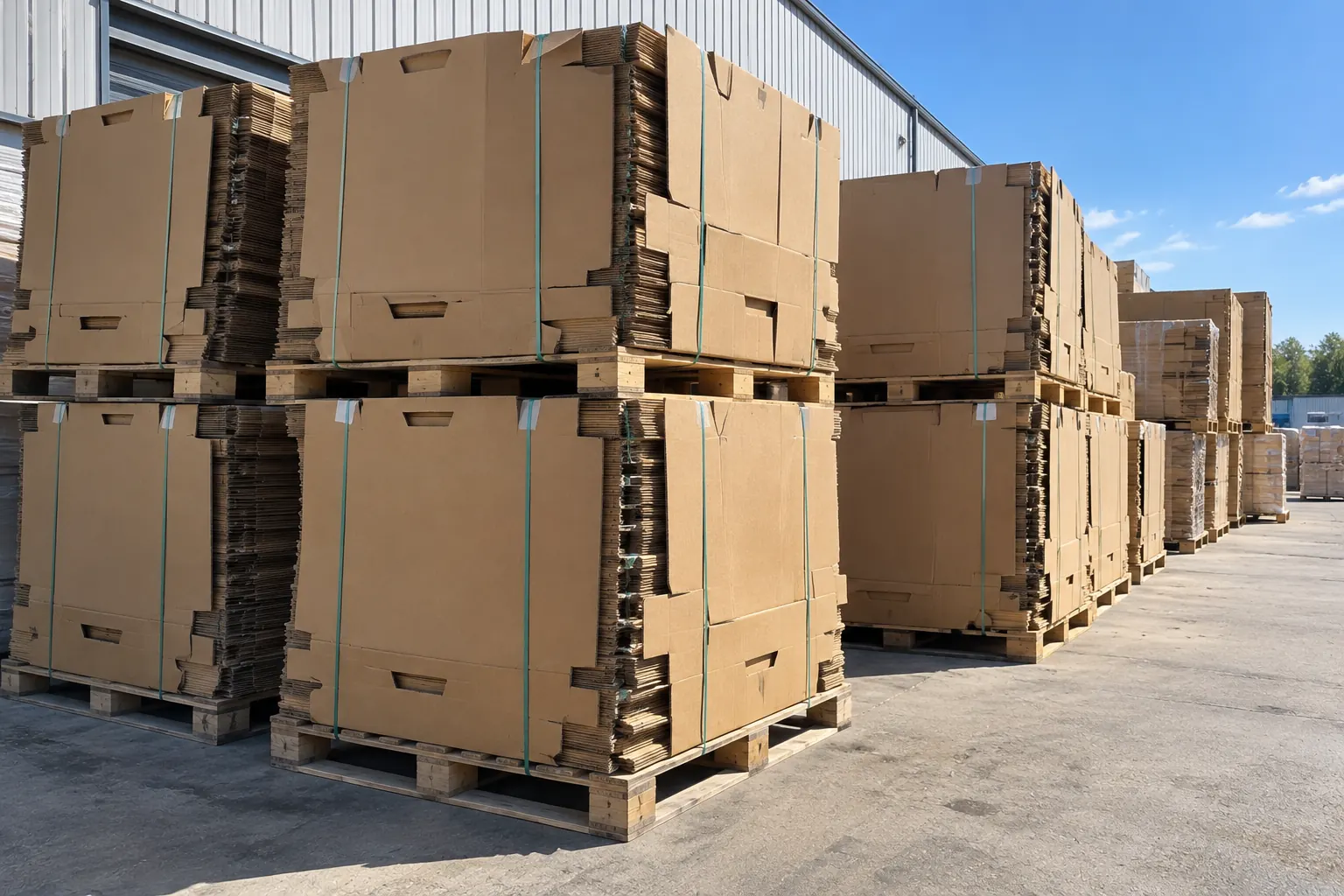
Four things in your photograph answer most of the pricing question.
Whether the stack is on pallets or on concrete. Whether there is colour banding on the liner. How square the corners look. And what is sitting underneath the bottom course.
Roughly 18 per cent of what arrives at our gate as recycling is still a usable container. That 18 per cent is the part you have been selling at commodity pricing.