Reconditioning
Our bench repairs what most yards throw away: flap replacement, panel patching, re-scoring, label removal and over-printing. A reconditioned gaylord costs a fraction of a new one.
Start: reconditioning
Pre-filled for this service. Add the detail and it reaches the floor.
The most profitable floor space we own
Not a sustainability gesture. A bench that turns a commodity bale back into a saleable container is simply the best use of a square foot in this building.
Four steps, in this order, every time.
Triage
Every inbound box is graded by hand. Repairable gets routed to the bench, not the baler.
Repair
Flap splices, patch panels, re-scoring, edge reinforcement with recovered board.
Clean the face
Label and residue removal, blank-out printing or your own single-colour mark.
Re-grade & release
Re-inspected, re-graded, bundled and released back into saleable stock.
A tired box, made presentable again.
Everything here happens out of one building at 9869 Meeks Blvd, St. Louis. That is not a detail — it is the only reason the numbers work.
What a bench can actually fix.
And, just as importantly, what it cannot — because a repaired box that fails is worse than a baled one.
| Repair | What it fixes | Added life | Limit |
|---|---|---|---|
| Flap splice | Torn, fuzzed or missing flap sections | 2 – 4 trips | Not viable if more than two flaps are gone |
| Patch panel | Punctures and tears away from load edges | 3 – 5 trips | Cannot patch a load-bearing vertical corner |
| Re-scoring | Cracked or softened fold lines | 2 – 3 trips | Will not restore a rounded, over-stuffed corner |
| Edge reinforcement | Crushed top edges on stacked units | 3 – 4 trips | Needs sound board either side of the crush |
| Label & residue removal | Adhesive, tape, old shipping labels | Appearance only | Heavy residue may need blank-out print instead |
| Blank-out printing | Previous owner's branding | Appearance only | Single colour; will not hide heavy multi-colour print |
| Delamination | — | None | We do not repair this. It goes to the baler. |
| Moisture damage through the flutes | — | None | Flutes never fully recover. Baler. |
Every repaired container is re-graded from scratch.
A repair does not inherit the original grade. The box goes back through the same grading station as a new arrival, and whatever it earns is what goes on the quote.
It is the only way the grade scale stays meaningful. If repaired boxes were graded generously, grade B would quietly become grade C within a year, and every customer would notice before we did.
Grade B — Good, light wear
Minor surface scuffs, light creasing on one panel, clean interior. All flaps intact and fully functional.
Reconditioning is not a discount. It is the difference between a box that gets four trips and a box that gets nine — and that difference is where the whole environmental case for reuse actually lives.
Seven repairs, and the limits of each.
Just as important as what a bench can fix is what it cannot. A repaired box that fails is worse than a baled one, and attempting the impossible repairs is how a yard destroys its own grade scale.
| Operation | Bench time | Life recovered | Material | Limit |
|---|---|---|---|---|
| Flap splice | 3 – 5 min | 2 – 4 trips | Recovered board offcut | Not viable past two missing flaps |
| Patch panel | 6 – 9 min | 3 – 5 trips | Recovered board offcut | Cannot patch a load-bearing vertical corner |
| Re-scoring | 2 – 3 min | 2 – 3 trips | None | Will not square a rounded corner |
| Edge reinforcement | 5 – 7 min | 3 – 4 trips | Recovered board strip | Needs sound board either side |
| Label & residue removal | 2 – 6 min | Appearance | Minimal | Heavy residue needs blank-out print |
| Blank-out printing | 1 – 2 min | Appearance | Ink | Single colour only |
| Corner post insertion | 8 – 12 min | 4 – 6 trips | Laminated board post | Only on triple wall |
The nine points, in the order a grader checks them.
Ordered by how well each point predicts failure under load, not by how obvious it is. The first one is the least visible and the most important.
| # | What is checked | What disqualifies | Downgrades to |
|---|---|---|---|
| 1 | Bottom third of the long panel | Soft, fuzzed or delaminated board from tine strikes | Recovery |
| 2 | Vertical corner squareness | Corners bowed outward from over-stuffing | C, or recovery if severe |
| 3 | Liner colour banding | Patchy darkening indicating moisture cycling | Recovery |
| 4 | Flap edge condition | Fuzzed or feathered edges; missing flap corners | C, or bench repair |
| 5 | Score line integrity | Cracked rather than creased folds | C, or bench re-score |
| 6 | Manufacturer's joint | Separated glue line or pulled staples | Bench repair |
| 7 | Interior cleanliness | Residue, dust, previous product traces | C |
| 8 | Print and label residue | Heavy multi-colour print or continuous tape bands | B at best; re-face station |
| 9 | Top edge crush | Crushing on stacked or racked units | Bench reinforcement, else C |
Eight failure modes, coded from our own retirements.
Ordered by share of retired containers. Note how few are repairable, and how many are prevented by something that costs almost nothing.
| Failure mode | Share | Repairable? | What prevents it |
|---|---|---|---|
| Forklift tine strike, lower long panel | 31% | Rarely | Floor approach guides, full-deck pallets, slower pick-face speed |
| Moisture through the flutes | 26% | No | Pallets not concrete, covered storage, let cold trailers equalise |
| Top-edge crush | 18% | Sometimes | Telescoping lids on anything stacked or racked |
| Strapping cut at the corner | 9% | Sometimes | Corner boards — the cheapest fix on this list |
| Corner rounding from over-stuffing | 7% | No | Do not fill above the top score line; buy the taller box |
| Cracked score lines | 5% | Yes, re-score | Separate lids instead of repeatedly folded flaps |
| Manufacturer's joint failure | 3% | Yes | Prefer stapled joints over glued for reuse |
| Delamination | 1% | No | Moisture control; there is no other cause worth chasing |
The strength you lose, and never get back.
Board that has been to 20% moisture and dried back to 9% does not recover its original strength. The damage is permanent and invisible — the box looks fine and fails at a load it used to carry.
| Moisture content | Edge crush retained | What it means | What we do |
|---|---|---|---|
| 6 – 8% | 100% | Specification condition, as tested at the mill | Nothing |
| 10% | ~90% | Normal conditioned warehouse | Nothing |
| 12% | ~80% | Noticeable softening; stacking margin eroding | Reduce stack height |
| 15% | ~60% | Do not stack; one more cycle at best | Grade down to C |
| 18% | ~45% | Structural life effectively over | Bench or baler |
| 20%+ | ~35% | Finished, even after drying back | Baler |
Why repair is the most profitable floor space we own
A triple-wall container failing first-pass grading with a torn flap has two futures. Baled, it realises its fibre value — a few dollars at a typical OCC price, less handling. Repaired, it takes four minutes of labour and an offcut of recovered board that cost us nothing, and re-enters stock as a graded saleable container worth many times that.
Across our volumes the bench recovers roughly 40% of what first-pass grading rejects. That 40% is the difference between a yard that sells boxes and a yard that sells cardboard, and it is why we have eight stations rather than a trestle table in a corner.
Consistency matters more than speed
Inconsistent repair work produces containers that fail in a customer's rack, and one rack failure costs more goodwill than fifty successful trips earn. So the bench has defined operations with defined limits, fixed lighting, and the same people doing the work often enough to be fast at it. Repair is a trade, not a spare-time activity.
Re-grading from zero
A container coming off the bench does not inherit its previous grade. It goes back through the full nine-point inspection as though it were a new arrival and earns whatever it earns. This is the mechanism that stops grade inflation — without it, grade B quietly becomes grade C within a year and every customer notices before we do.
The effect nobody predicted
Having a visible, routine repair operation changed how everyone in the building thinks about damage. Receiving staff started flagging containers instead of discarding them. Forklift drivers started noticing what they were doing to the lower third of a panel. The upstream behaviour change has been worth more than the direct recovery, and we did not plan it.
Five failures we will not attempt to fix.
A repaired container that fails is worse than a baled one. These five go to the baler or the press every time, regardless of how good the rest of the box looks.
Delamination
Liner separated from medium. The structural sandwich has come apart and no adhesive restores it.
Moisture through the flutes
The flutes have taken a set. Drying the board back does not recover the stiffness, and the failure is invisible until it is load-bearing.
Crushed load-bearing corner
The vertical corners are the columns. Nothing you glue on the outside restores a crushed flute line running through one.
More than two missing flaps
There is no longer enough geometry to splice to, and a splice needs sound board on both sides of the joint.
Rounded corners from over-stuffing
Re-scoring will not square a corner that has been permanently deformed. The container will not stack and should not be sold as though it will.
Five levels, and what each is good for.
No level of cleaning makes a used corrugated container suitable for direct food contact. What it does is make a container acceptable for its actual application, which is a different and answerable question.
| Level | Method | Suited to |
|---|---|---|
| Visual inspection only | Grading station check for residue and odour | General industrial, scrap, internal moves |
| Vacuum and blow-down | Compressed air and industrial vacuum | Resin, granulate, dusty materials |
| Label and residue removal | Mechanical removal at the re-face station | Anything customer-facing |
| Liner barrier | New FDA-compliant liner each cycle | Food ingredients, pet food, produce |
| Secure destruction | Shredding and baling with certification | Branded or regulated containers |
Seven ways to put a mark on a box.
Ranked roughly by setup cost. The last two are what we use on recovered board — removing somebody else's brand is a different job from applying your own.
| Method | Setup cost | Quality | Recyclability | Use | Lead time |
|---|---|---|---|---|---|
| Flexographic, 1 colour | Low | Basic | Fully | Identification, logistics marks | 3 – 7 days |
| Flexographic, 2 – 4 colour | Medium | Good | Fully | Brand on shipper | 10 – 15 days |
| High-graphic flexo | High | Very good | Fully | Retail-ready packaging | 15 – 20 days |
| Litho-lamination | Very high | Photographic | Reduced | Premium retail display | 20 – 30 days |
| Digital inkjet | None | Good | Fully | Short runs, versioning | 3 – 10 days |
| Blank-out over-print | None | Functional | Fully | Removing a previous owner's brand | Same day |
| Stencil | None | Industrial | Fully | Pool container marking | Same day |
What the rack does to the box.
Container specification and racking choice are the same decision made twice. Drive-in and push-back racking are where we see the most container damage, because the container is handled blind.
| Rack type | Beam span | Load capacity | Effect on containers |
|---|---|---|---|
| Selective pallet rack | 96 – 144" | 2,500 – 6,000 lb/level | Most common; one pallet deep |
| Double deep | 96 – 108" | 2,500 – 5,000 lb/level | Needs a reach truck; container squareness critical |
| Drive-in | N/A, rails | 2,000 – 4,000 lb/pallet | Container damage risk is highest here |
| Push-back | 96 – 120" | 2,200 – 4,500 lb/pallet | Dynamic load; overhang is unforgiving |
| Pallet flow | 96 – 120" | 2,000 – 3,000 lb/pallet | Bottom-board condition decides whether it rolls |
| Floor stacking | N/A | Board-limited | Where box compression strength actually binds |
| Item | Limit | Note |
|---|---|---|
| Single-person lift, ideal zone | Up to 35 lb | Between knuckle and shoulder height, close to the body |
| Single-person lift, absolute | 50 lb | Common carrier and insurer threshold for cartons |
| Two-person lift | Up to 100 lb | Requires clear path and matched heights |
| Carton max gross, 32 ECT | 65 lb | Certificate limit, not a handling recommendation |
| Carton max gross, 48 ECT | 120 lb | Mechanical handling expected |
| Gaylord, loaded | 1,800 – 2,400 lb | Forklift or pallet truck only |
| Pallet jack, manual | 5,500 lb | Flat floors only |
| Counterbalance forklift, typical | 5,000 lb at 24" load centre | Derates sharply as load centre moves out |
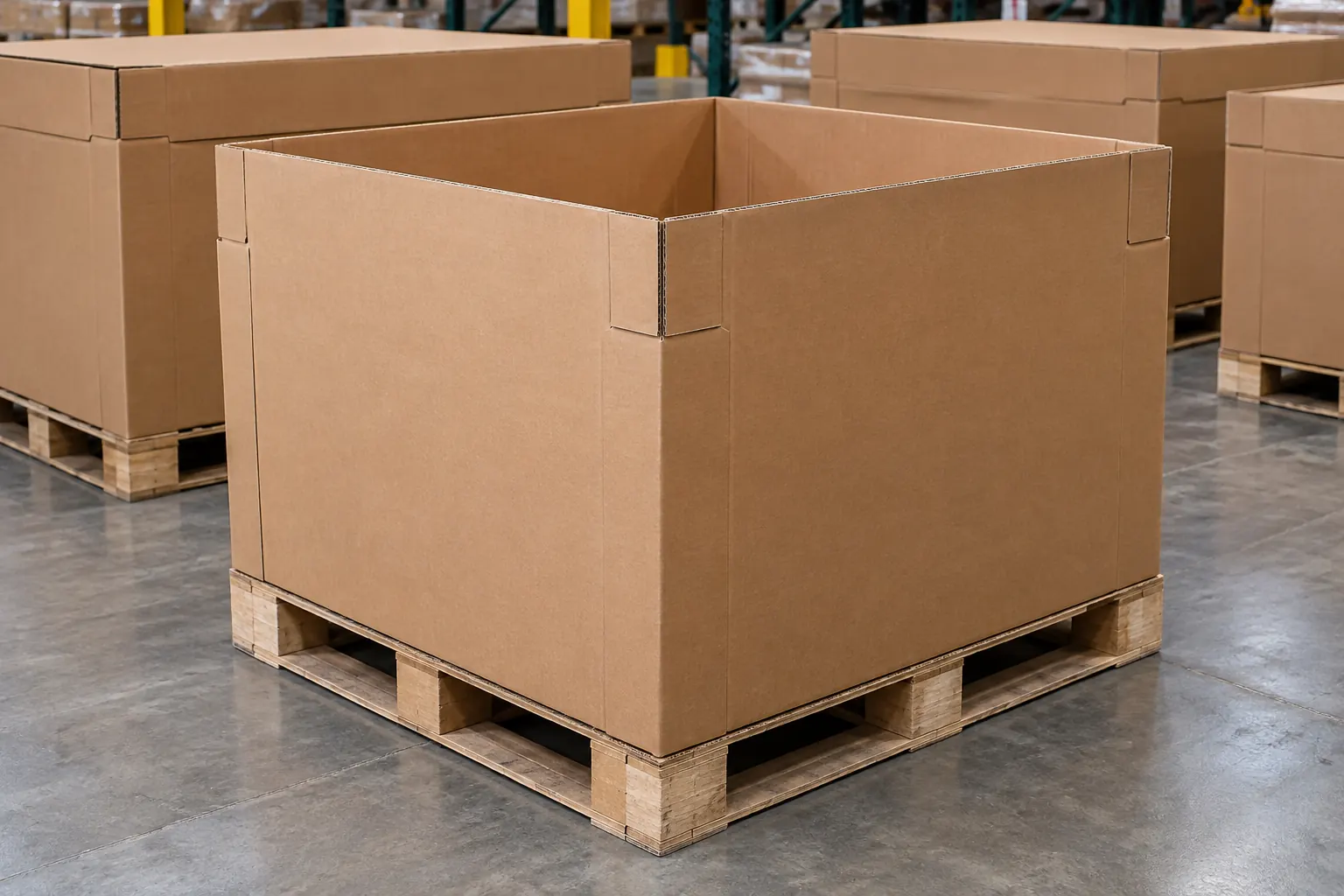
Forty per cent of first-pass rejects come back as saleable stock.
This container failed first-pass grading. Four minutes at a bench, an offcut of recovered board that cost us nothing, and it re-enters stock as a graded container worth many times its fibre value.
The bench is the most profitable floor space we own, and that is arithmetic rather than sentiment.